OKC's strategy of paying young non-superstars has once again paid off -- and almost certainly will next time too
 By Sam Quinn May 10, 2026 at 10:04 am ET • 11 min read
  Getty Images
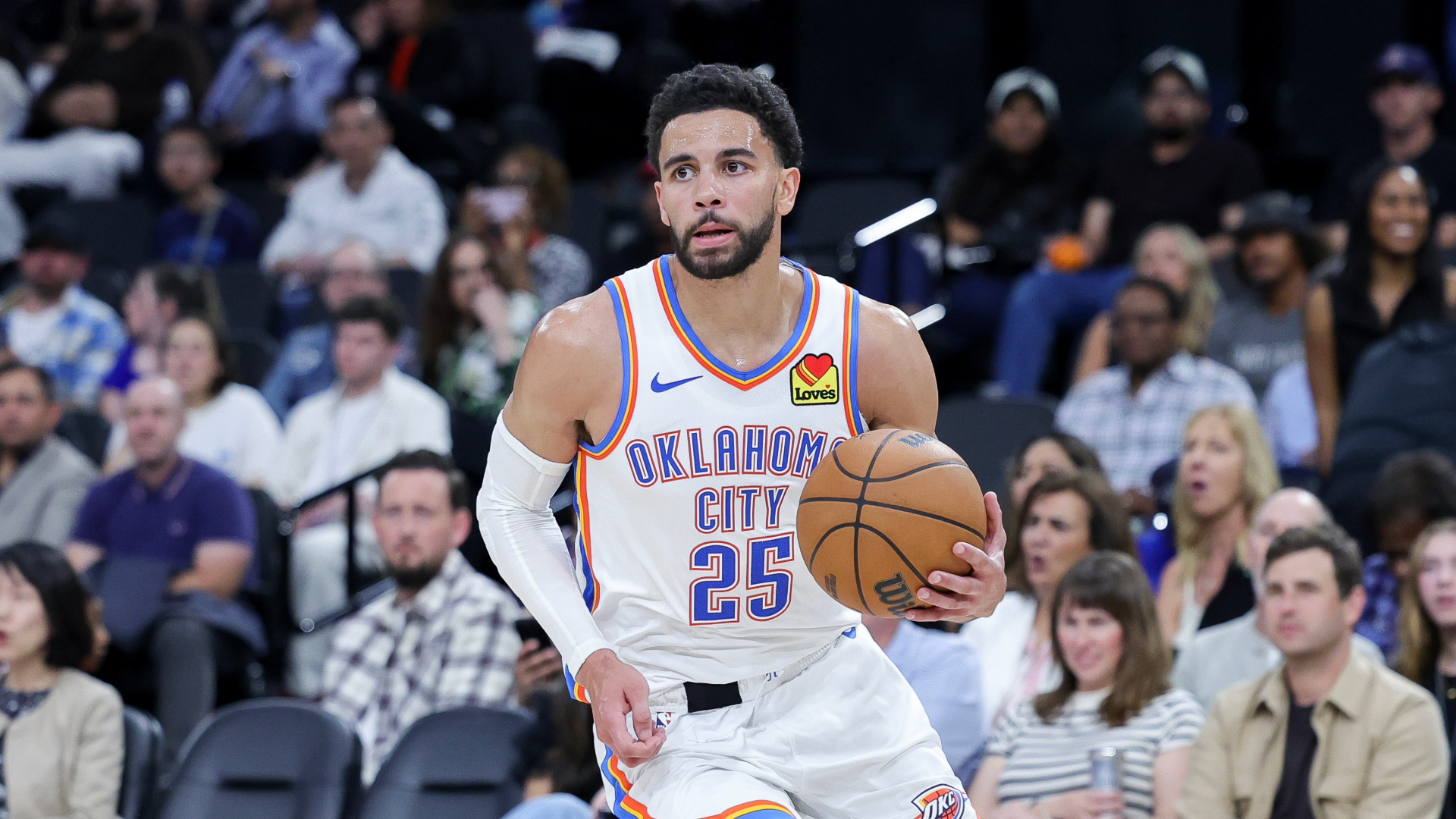
 Mathematically speaking, most of you reading this are probably fans of one of the 29 NBA teams trying (and mostly failing) to keep up with the Oklahoma City Thunder. You're watching their second-round beatdown of the Los Angeles Lakers and groaning over the ascent of second-year guard Ajay Mitchell.
Through three games, Mitchell has statistically been the equal of reigning MVP Shai Gilgeous-Alexander. He's scored one fewer point on three fewer shots with three more assists. The frequent Jalen Brunson comparisons are looking more and more realistic with each passing day. Great, you're sarcastically thinking, the Thunder have unearthed yet another possible star.
But you're an astute observer of the modern NBA. You understand how complicated roster-building has become. "They may have found him," you assure yourself, "but they'll never be able to afford to keep him with the second apron and luxury tax looming." Then you meander over to Spotrac to check his contract and spit out the coffee I've decided you were drinking. Three years, $9 million. How?!? How did the Thunder do this again? Oklahoma City has not only unearthed this diamond in the rough, but had the foresight to secure a long-term commitment out of him before the rest of the world realized what they'd found.
So how did that happen? Well, by this point, you probably won't be surprised to hear that Sam Presti is very good at this whole "roster-building" thing. One of the many things the Thunders do exceptionally well is manage contracts, and Oklahoma City secured Mitchell using a version of a tactic they've applied to a number of their under-the-radar discoveries over the years. So let's dive into the cap mechanics of how the Thunder locked Mitchell into what now looks like the best contract in basketball.
The build-up
Ajay Mitchell was the No. 38 overall pick in the 2024 NBA Draft, but that alone doesn't do justice to how unconventional his path here was. He grew up in Belgium, moved to France, briefly played there with Victor Wembanyama, then played just two games for Limburg United's senior team back in Belgium. From there, he moved on to UC Santa Barbara, not exactly an NIL powerhouse. He grew into an All-Big West player there, but still, it's the Big West. He wasn't exactly high on many radars as he went through the 2024 draft process.
So he signed a two-way deal with the Thunder after they took him in the second round. He was an immediate summer league standout, averaging just shy of 20 points across six games, and that bought him some early regular-season playing time. He ran with it, averaging 16.5 minutes in 34 games early in the season. But in January 2025, he suffered a toe injury that required surgery, stalling his momentum. Still, the Thunder were impressed enough with what they saw to convert his two-way deal to a standard contract.
Now, when a team wants to convert a two-way player, they can do so unilaterally by turning his deal into a minimum, standard contract for the rest of the season. But that's not what the Thunder did. In exchange for an extra year of control with a 2025-26 team option, the Thunder, using their cap room mid-level exception, bumped him up to a two-year, $6 million contract. Since the standard, rookie minimum contract is only a bit above $1 million, that's a pretty considerable jump for a second-round pick. At the time, Mitchell was injured and guaranteed nothing, so he eagerly accepted.
He wasn't heard from much from there, playing in only two more regular-season games and making spot appearances in the playoffs, mostly in garbage time. But the Thunder liked what they saw.
Restricted free agency and team options
Plenty of teams, when presented with cheap team options, simply pick them up and keep their players on low cap figures. Take the Kings, who had a $2.3 million team option on defensive guard Keon Ellis. Had they declined it, he would have been a restricted free agent. They could have matched any offer and controlled the process, likely getting him to sign a favorable, longer-term deal. Instead, they kept that low cap figure and used the money it saved to pursue Dennis Schröder on a mid-level contract, setting Ellis up to become an unrestricted free agent in 2026. They were widely criticized for doing so and wound up using Ellis to dump Schröder's contract at the deadline.
The Thunder almost never do this. When their players have team options, they almost universally decline them, send their players to restricted free agency and re-sign them on long-term deals. In fact, they've done versions of this with four other players in their rotation:
- In 2022, the Thunder declined a $1.9 million team option on Lu Dort, which allowed him to reach restricted free agency. From there, they re-signed him to a five-year, $87.5 million deal with a team option for the 2026-27 season. That contract has largely been a bargain, but nowhere near the bargain the previous, long-term minimum deal he signed had been.
- In 2024, the Thunder declined team options on both Isaiah Joe and Aaron Wiggins. This technically made Joe an unrestricted free agent and Wiggins a restricted free agent. However, the fact that the Thunder could have kept both of them for about $2 million each for the 2024-25 season incentivized them to sign longer-term deals on team-friendly terms so they could get immediate raises. Joe got a four-year, $48 million pact that came with a 2027-28 team option. Wiggins got a five-year, $45 million deal that came with a 2028-29 team option.
- In 2025, the Thunder declined Jaylin Williams' $2.1 million team option. That made him a restricted free agent, and they re-signed him for $24 million over three years. You will be shocked to hear that the Thunder gave him a team option for the 2027-28 campaign.
This is how the Thunder handle virtually every sub-star contract on their books. The idea is to pay them as early as possible, but to do so using options and restricted free agency as leverage to secure the longest possible deals. It's a win-win: the players get paid earlier than they might on other teams. The Thunder are happy to do so. They largely haven't had to deal with financial crunches yet during this rebuild, so there's room in their budget to front-load deals. The value comes at the back end, when these players are making less than they're worth in the prime of their career, and their contracts come with options that either make the players easier to trade or easier to renegotiate with down the line. Even Isaiah Hartenstein, the most prominent external free agent they've signed, came with a team option in the final year of his deal.
Mitchell's decision
One of the keys to all of this for the Thunder has been how cheap rebuilding rosters tend to be. They generally haven't been up against the tax or the aprons because they've been drafting and developing, so paying players early hasn't been a problem. That's about to change. Jalen Williams and Chet Holmgren both signed max rookie extensions last offseason. They kick in next year, which will take the Thunder from below the tax to well above the second apron without further moves.
This made getting Mitchell secured long-term and early essential. They could have played out the 2025-26 season with him on his existing contract, but they clearly envisioned a bigger role for him. They almost certainly didn't see this coming. After all, they drafted Dillon Jones above him just one year earlier. But they clearly wanted Mitchell to play, and if he played well, that would risk some other team throwing a sizable offer sheet his way in restricted free agency that would plunge them deeper into the tax and make it harder to eventually duck the second apron. So getting him locked in for multiple years was paramount.
That's where the three-year, $9 million deal comes in. At the time, Mitchell had only made his scant rookie salary. This deal didn't change his salary for the 2025-26 season compared to what it would have been on the team option, but it did guarantee him another $1.5 million for the 2026-27 campaign and, assuming he believed he'd proven enough to remain on the roster, $6 million in total over the 2026-27 and 2027-28 seasons.
You could argue that he should have turned down the deal and bet on himself. Had the Thunder declined the option without a new deal in place, they would have given him a one-year, $4.05 million qualifying offer. More likely, the Thunder would have just picked up his option in that scenario. He could have played out the season and become a restricted free agent in 2026. The only lost guarantee would have been that $1.5 million for the 2025-26 season.
That looks like a pittance in NBA terms since we so frequently see nine-figure deals, but the league is a vast ecosystem. Not everyone is getting the max. For second-round picks and undrafted free agents, players whose futures aren't guaranteed, especially those coming off of surgery, it's a lot of money.
More than that, it's a signal of a team's commitment. Work with them on a multi-year deal and they're likely to continue investing in your development by giving you minutes and keeping you around. Oklahoma City has the best developmental infrastructure in the NBA. It's enormously well-regarded by players and agents tend to like placing clients there. Players almost always have a higher opinion of themselves than most. They're often eager to bet on themselves. It's up to their agents to lay out the bigger picture.
Landing in the wrong situation can do a lot of long-term damage. On the best roster in the NBA, Mitchell didn't know how much playing time he could reasonably expect. Remember, part of the reason he played as much as he did this season was the injuries Jalen Williams and other teammates dealt with. That opened up shots and minutes that have been enormously beneficial to him. There was a world in which he didn't play much this season, and therefore didn't substantially increase his market value going into restricted free agency in 2026. Since the Thunder had a full roster, the impending returns of previous first-round picks Nikola Topić and Thomas Sorber and up to four 2026 first-round picks incoming might have cost him his place with the Thunder.
So he took a bit of financial security and sacrificed two years of team control in doing so, but assured himself placement in the NBA's best talent incubator. He's underpaid right now, but he's also proving that he's capable of starring on the playoff stage. In the long run, that's probably going to make him more money. Speaking of which...
Mitchell's next contract
If Mitchell plays out his existing contract, he will be an unrestricted free agent following his age-25 season in the summer of 2028. Even if he's completely done improving, the mere memory of Brunson's ascent after reaching New York would get him massive offers, and the fact that he's bigger and a better defender than Brunson makes him a fit on far more teams. When you factor in the likelihood that he has more growing to do as a player, the possibilities get even bigger. What if he's a star in two years? Could he generate max offers?
It's too early to say. We also may not find out. Why? Because we're talking about the Thunder here, so of course Mitchell's existing three-year contract contains a team option for the 2027-28 season. If their history is any indication, they will try to use that option to get him to agree to a new, team-friendly, long-term deal. At that point, he'll have made single-digit millions of dollars and will likely have a nine-figure offer in front of him. Considering the risk of playing things out from there, he has a lot of reason to consider re-upping at that point.
Now, the Thunder have a number of other enormous financial obligations on their plate. Gilgeous-Alexander starts a supermax deal in the 2027-28 season, for instance, which is also when Cason Wallace's rookie deal kicks in. At that point, they may decide Mitchell is a luxury they can no longer afford. This is where you, the fan of a non-Thunder team, celebrate the notion of Oklahoma City potentially getting worse for a change. Don't bother. Virtually every version of this plays out well for the Thunder.
If Oklahoma City decides to trade him early, it probably gets a haul for him. His tiny existing salary makes him easy to fit on any roster. The entire league would be trying to get him, and the trade offers would reflect that. Or maybe the Thunder just play this out organically, keep him as one of the league's best bargains at his near-minimum salary for two years, win two more championships, and replace him with some other cheap draft pick in 2028.
The exact mechanism by which the Thunder benefit from the incredible contract they signed Mitchell to is not yet clear, but they're going to benefit enormously. That's almost always how it works for them because their front office is so aggressive about locking players up early to the most advantageous terms possible.
Join the Conversation comments