
 South Africans at all income levels, foreign and local retirees and digital nomads have all moved to Cape Town. Photograph: Hongqi Zhang/AlamySouth Africans at all income levels, foreign and local retirees and digital nomads have all moved to Cape Town. Photograph: Hongqi Zhang/AlamyAirbnb in firing line as Cape Town’s housing crisis catches up with middle class
Social media full of complaints about digital nomads, while waiting list for social housing gets longer
Earlier this month, graffiti appeared on the promenade in Sea Point, on Cape Town’s wealthy Atlantic Seaboard: “Digital nomads go home! Now!”
Social media is full of complaints about the abundance of American and German accents, foreign property buyers, and properties being listed on Airbnb, all of which are being blamed for soaring housing costs.
In the last five years, property prices have risen 31%, according to official data. That was double the rise across South Africa’s seven other metropolitan municipalities. Rents grew 5-7% last year, also above the national average, according to The Africanvestor, a property research firm.
Cape Town has suffered from a housing crisis long before middle class residents started feeling the pinch. Like most of South Africa, the geographic inequality of apartheid persists, more than 30 years since the end of white minority rule. Townships, where non-white people were forcibly moved to from the 1960s, remain largely non-white and poor. Informal settlements have mushroomed.
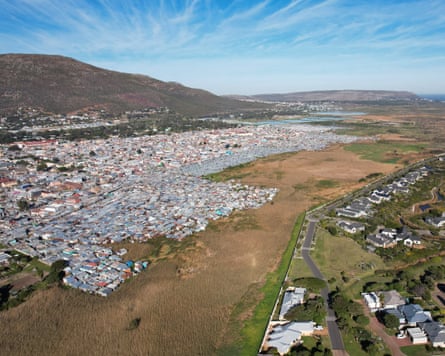 A drone view of an informal settlement extending into wetlands in Cape Town. Photograph: Nic Bothma/Reuters
Cape Town is generally considered South Africa’s best-run city, in a province with the country’s lowest unemployment rates. This has lured people at all income levels, including “semigrants” from other parts of the country, foreign and local retirees and digital nomads.
But it has also long had insufficient housing and infrastructure development, according to experts. The city’s population grew 65% to 4.8 million between 2001 and 2022. More than 400,000 were on the waiting list for social housing in September 2024, according to the most recent city government data, while 18.8% of residents lived in informal housing.
While the national government funds social housing, cities are responsible for infrastructure and services such as rubbish collection. Ivan Turok, a University the Free State professor who has studied housing in Cape Town, said the city long neglected the latter for poorer people moving there.
He said: “There was an historically somewhat conservative mentality, on the part of civic leaders, that Cape Town is an attractive and desirable city and will be spoiled with large-scale growth … That’s changing now, because the city recognises that it’s inevitable.”
Jean-Marie de Waal Pressly, a spokesperson for the city government, said more land had been released for affordable housing since mayor Geordin Hill-Lewis took office in November 2021 than over the previous decade, with 12,000 affordable units in the pipeline. “The city is committed to reversing the impact of apartheid spatial planning by bringing jobs closer to people and bringing people closer to jobs,” he said.
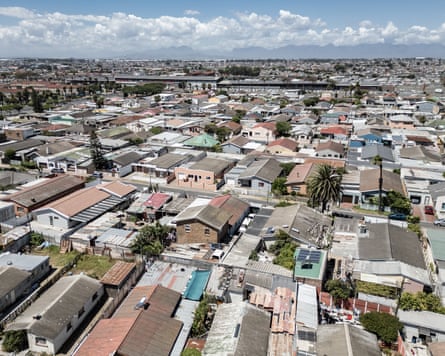 An aerial view of the Manenberg neighbourhood of Cape Town. Photograph: Tommy Trenchard/The Guardian
In January, a video of Alexandra Hayes, 31, went viral. The freelance operations manager and waitress, tearfully explained how she and her daughter were facing homelessness. Her lease had not been renewed, as the landlord was listing the property on Airbnb. The video struck a nerve, both among people empathising with Hayes and non-white South Africans saying, “I told you so.”
“You guys thought you were the exception to the rule. Capitalism doesn’t give a damn about what race you are. You might be white, but you are South African,” current affairs commentator Amahle-Imvelo Jaxa said in a TikTok video that got almost 700,000 views.
In an interview, Jaxa said: “The conversation around housing in Cape Town has been going on for at least 10 years. And we’d get comments from white people: ‘Well, if you can’t afford to live in the city, you should move to the outskirts’.
“And if you’ve been to Cape Town, you know exactly what that means. It’s that if you cannot afford to be one of us, you need to go to the township, you shouldn’t actually be here and sit with us.”
Hayes, who earns around 20,000 rand (£895) a month and is currently living with friends and family, agreed with Jaxa. “When apartheid ended … they never really paid attention to bring up the [historically] non-white areas up to the same standard of the white areas,” she said.
Meanwhile, non-white people who can afford to live in Cape Town’s more desirable neighbourhoods are still facing racism when trying to rent. Ayodele Ogunnoiki, a Nigerian non-profit worker who has lived in Cape Town since 2011, is facing long wait times to hear back from landlords and estate agents, while her Norwegian-Hungarian husband gets far quicker responses. “Being married to a white man, irrespective of his background, has enhanced my profile,” she said.
Much of the middle class ire about the increasing difficulty of finding an affordable place to rent has been directed at Airbnb. There are more than 26,000 listings in Cape Town, 82.6% of them entire homes, according to advocacy group Inside Airbnb. That is higher than numerous cities worldwide including Copenhagen, Lisbon and Los Angeles.
An Airbnb spokesperson said: “Airbnb takes claims about housing affordability very seriously. We are acutely aware of Cape Town’s housing challenges, rooted in the city’s unique geography, the lasting impact of apartheid-era land dispossession and exclusionary spatial planning.”
They said that short-term lets accounted for less than 0.9% of formal housing in Cape Town last year and that that proportion had fallen since 2020, adding: “What the evidence consistently shows is that the fundamental problem, globally, is the lack of homes being built to meet increasing housing needs.”
De Waal Pressly said the city was introducing a bylaw to make sure short-term landlords would pay commercial rather than residential tax rates.
Explore more on these topicsShareReuse this content