How Tyler Linderbaum's deal in NFL free agency will make a lasting impact
By Joel Corry Apr 1, 2026 at 1:59 pm ET • 6 min read Imagn Images
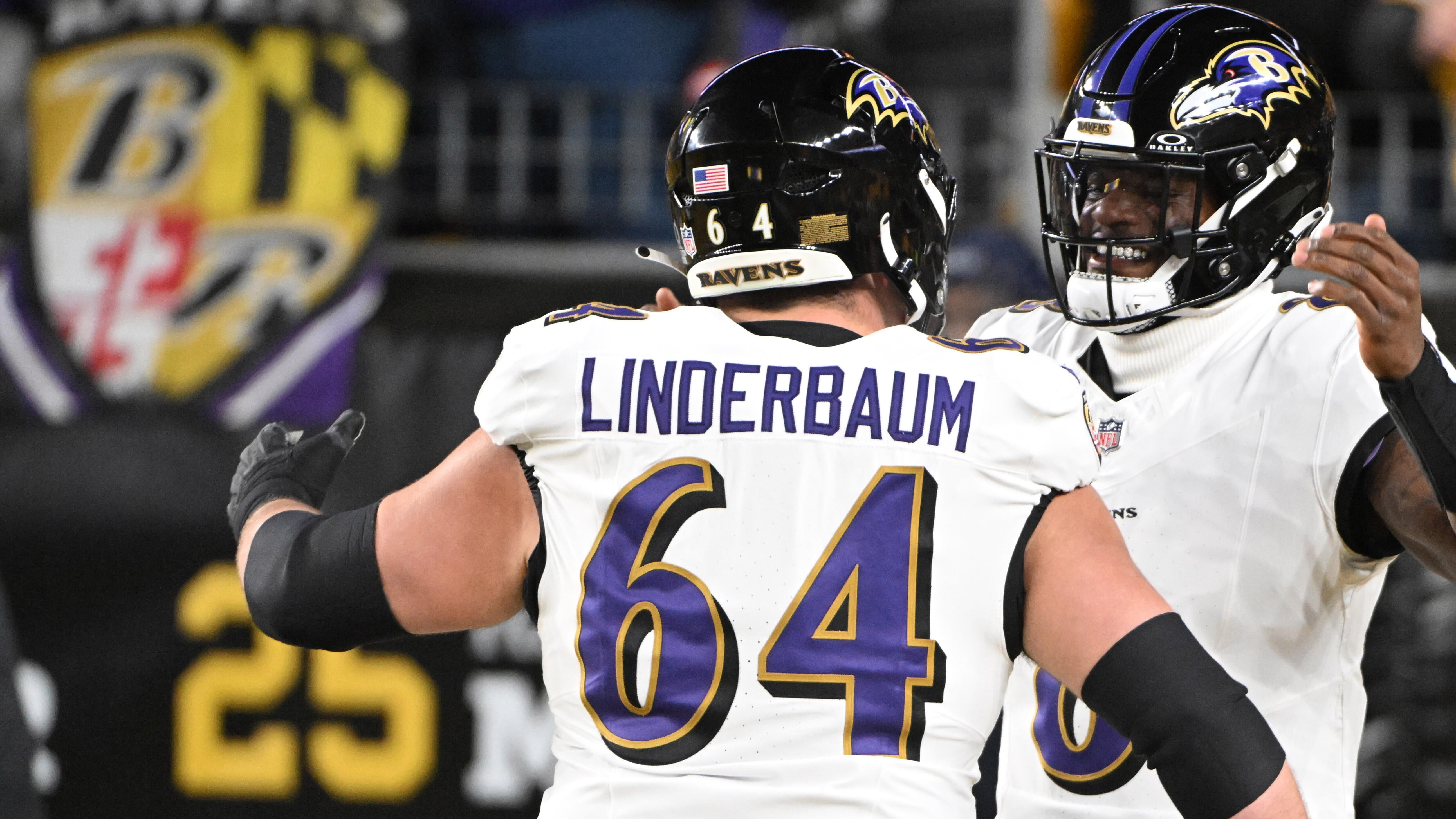
 The most surprising development in free agency was Tyler Linderbaum's contract even though it was inevitable that he would become the NFL's highest-paid center with his new deal. Reports indicated that Linderbaum's camp sought $25 million per year after Baltimore Ravens general manager Eric DeCosta revealed during the NFL Combine that he offered the three-time Pro Bowl center a market-setting contract to prevent him from becoming a free agent.
Linderbaum apparently had his sights set on not only being the league's highest-paid center, but also the league's wealthiest interior offensive lineman. The mark to beat for Linderbaum was the four-year, $96 million contract extension agreed upon between the Dallas Cowboys and guard Tyler Smith. That deal, signed last September, averaged $24 million per year.
Conventional wisdom suggested that Linderbaum would fall short of his target price. A $25 million per year deal would have been a phenomenal 38.9% increase over the four-year, $72 million extension Creed Humphrey received from the Kansas City Chiefs. That deal, worth $18 million per year, paced the center market when it came into place two offseasons ago.
The edge rusher market collectively moved 36.76% in 2025 with Maxx Crosby, Myles Garrett, T.J. Watt and Micah Parsons each becoming the salary standard. Parsons signed a four-year, $186 million extension at the end of last August in connection with his trade from the Dallas Cowboys to become the NFL's highest-paid non-quarterback at $46.5 million per year.
Nobody expected Linderbaum to get a three-year, $81 million contract with $60 million fully guaranteed from the Raiders. Linderbaum's $27 million per year reset the center market by a whopping 50%.
The entire $81 million is practically fully guaranteed. Linderbaum's injury guaranteed $21 million base salary in 2028 becomes fully guaranteed next March. There's also a clause in Linderbaum's contract preventing the Raiders from placing 2029 franchise or transition tags upon him.
Generally, high-end contracts are made to be surpassed. That may not happen quickly in the center market with Linderbaum's deal.
The interior defensive line market with Aaron Donald may be more indicative of how the center market will develop over time. A couple of days after the Los Angeles Rams won Super Bowl LVI in February 2022, it was reported that Donald looked to become the league's highest-paid defensive player with a 15% markup over Watt's $28,002,750 per year to keep playing instead of retiring.
Donald had been the NFL's highest-paid interior defensive lineman since signing a six-year, $135 million extension averaging $22.5 million per year shortly before the start of the 2018 regular season to end his holdout. The three-time NFL Defensive Player of the Year, who was arguably the league's best player regardless of position, felt underpaid.
The Rams did something for Donald that rarely happens in the NFL. His contract with three remaining years worth $55 million was essentially ripped up and replaced with a three-year, $95 million deal, making him the NFL's highest-paid non-quarterback.
DeForest Buckner was the league's second-highest-paid interior defensive lineman on the four-year, $84 million extension he received from the Indianapolis Colts when he was acquired from the San Francisco 49ers. Donald's $31,666,667 per year was 50.79% more than Buckner's $21 million per year.
Multiple interior defensive linemen, including Dexter Lawrence, Jeffery Simmons and Quinnen Williams, leapfrogged Buckner in 2023. Donald's deal was essentially treated as an outlier, where nobody got close. Williams was the NFL's second-highest paid at the position, averaging $24 million from the New York Jets. Donald's deal was still 32% more than the rest of the market after the 2023 signings.
The Kansas City Chiefs had planned on extending All-Pro defensive tackle Chris Jones' contract after winning Super Bowl LVII, since 2023 was his contract year. A refusal to put Jones in the same salary stratosphere as Donald led to his lengthy holdout. That ended after Kansas City's regular-season opener when performance bonuses were added to his contract.
Jones eventually topped Donald in March 2024. He signed a five-year, $158.75 million contract averaging $31.75 million per year. Most important to Jones was having more than Donald's $95 million in cash over his first three years, which he got with $95.3 million.
There still hasn't been another interior defensive lineman to hit the $30 million per mark besides Donald and Jones. Only three others went above the $25 million per year mark: Christian Wilkins at $27.5 million per year, Jordan Davis at $26 million per year and Milton Williams at $26 million per year.
Other NFL teams trying to treat Linderbaum's contract as a market anomaly is to be expected. Centers drafted in 2024 that will be in contract years in 2027, such as Tanor Bortolini and Zach Frazier with the Colts and Steelers, respectively, should jump over Humphrey's $18 million per year. Such draftees won't be eligible to sign new deals until the 2026 regular season ends next January 10. Getting to $20 million per year would create a 35% gap with Linderbaum, which would be comparable to the difference between Donald and Williams in 2023.
Humphrey arguably has the biggest financial gripe. He's generally regarded as the league's best center with a pair of First Team All-Pro honors.
The Chiefs probably don't have any urgency to address the discrepancy in pay with Linderbaum. Humphrey enters the second new contract year of his four-year extension, and his deal expires after the 2028 season.
If how the Chiefs handled Jones' situation is any indication, Humphrey may have to play at least through the 2027 season under his current deal. It would behoove the Chiefs to make extending Humphrey's contract a top offseason priority in 2028. As long as Linderbaum remains a top center over the next two years, the inability of the Raiders to keep him hitting the open market in 2029 will give him significant leverage during any discussions about a new deal in 2028.
The biggest immediate beneficiary of Linderbaum's deal won't be a center. It's probably going to be Colts eight-time Pro Bowl offensive guard Quenton Nelson since he is in a contract year. He should get a contract extension at some point before the 2026 regular season starts.
Nelson was the league's first $20 million per year interior offensive lineman in 2022 when he reset the offensive guard market by 21.21% with his four-year, $80 million extension. Getting to $25 million per year was likely an important salary benchmark for Nelson before Linderbam's deal.
Nelson probably raised his salary expectations because of Linderbaum's contract. Prior to Linderbaum, the last time a center was the NFL's highest-paid interior offensive lineman was in 2015. Mike Pouncey's five-year extension with the Miami Dolphins averaged $8.95 million per year. Logan Mankins led offensive guards at $8.5 million per year. He signed a six-year, $51 million contract with the New England Patriots in 2011. It should be noted that the Tampa Bay Buccaneers released offensive guard Carl Nicks from the five-year, $47.5 million deal, averaging $9.5 million per year, he signed during 2012 free agency in August 2014.
It wouldn't be surprising for Nelson to insist on rectifying the anomaly. Nelson getting an increase in the guard market comparable to 2022's would seem to be a stretch. That would put Nelson in the $29 million per year neighborhood. Offensive tackle Laremy Tunsil is the only NFL offensive lineman at or above $29 million per year with the two-year, $60.2 million extension he recently signed with the Washington Commanders.
Joel Corry is a former sports agent who helped found Premier Sports & Entertainment, a sports management firm that represents professional athletes and coaches. Prior to his tenure at Premier, Joel worked for Management Plus Enterprises, which represented Shaquille O'Neal, Hakeem Olajuwon and Ronnie Lott.
You can follow him on twitter: @corryjoel
You can email him at [email protected].
Join the Conversation comments