NFL teams have become increasingly comfortable with significant amounts of dead money, meaning salary cap charges for players that are no longer on a team's roster. Just look at the Miami Dolphins.
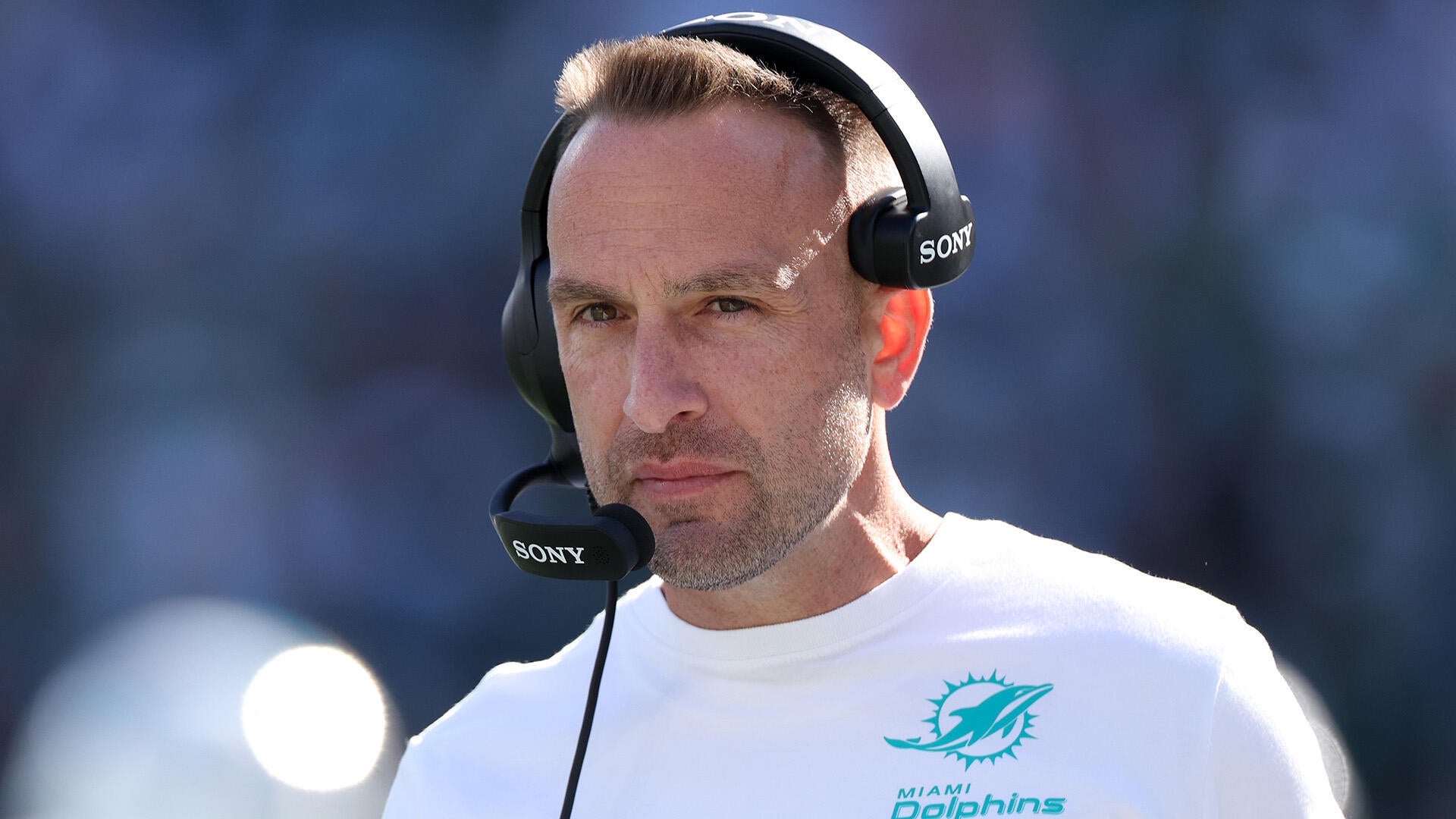
Under general manager Jon-Eric Sullivan and head coach Jeff Hafley, who were both previously with the Green Bay Packers before being hired in January, the team is taking dead money to an extreme. The new regime has an unprecedented $188.88 million in dead money as of Week 10's loss to the Indianapolis Colts.
However, there's a method to Sullivan's madness as the Dolphins are in teardown mode after a 7-10 record in 2025 with a high-priced roster.
"There are two philosophies that you can subscribe to in the National Football League: You pay as you go or you're living on credit," Sullivan said during the offseason. "If we keep living on credit, we're never going to get healthy. …We can't get there unless we kind of take it on the chin this year. We're not going to live like this every year. But this year we had to move like this to get back within a healthy salary cap."
Miami's $188.88 million is easily the most dead money in NFL history for a league year. The record-breaking amount has put the Dolphins at a distinct financial and competitive disadvantage, so it's no surprise that Miami is in a three-way race with the Los Angeles Chargers and the Tennessee Titans for the first overall pick in the 2027 NFL Draft. Each team has a 1-8 record.
So where does Miami go from here with its mess of dead money? Let's dive in.
Where is Dolphins' dead money going?
Miami's $188.88 million in dead money is on par with the league-wide salary cap in 2019, which was $188.2 million (the current salary cap is $301.2 million). Each team's actual salary cap (known as the adjusted salary cap) typically differs from the NFL's set amount because unused cap room can be carried over from one year to the next, and other adjustments can further increase or decrease cap space.
The Dolphins have a $308.878 million adjusted salary cap for 2026, and dead money takes up an unheard-of 61.15% of that number. Just under $120 million in cap space is available for the actual roster, thanks to dead money. Essentially, the Dolphins are building a team this year under salary cap constraints from 15 years ago — the league-wide salary cap was $120.375 million in 2011 following 2010's uncapped year.
Most of Miami's dead money comes from just a handful of players. The Dolphins have four of 2026's biggest dead-money charges from the following players (league ranking is in parentheses):
- Tua Tagovailoa (QB): $55.4 million (1st)
- Tyreek Hill (WR): $28.2 million (6th)
- Jaylen Waddle (WR): $23.2 million (10th)
- Jalen Ramsey (CB): $20.9 million (13th)
Inside Tua's dead money: As expected, the new regime went in a different direction at quarterback. Tagovailoa was benched and demoted to third-string quarterback by former Dolphins head coach Mike McDaniel after 14 games last season. He had three years remaining on the four-year, $212.4 million contract extension averaging $53.1 million per year, signed in July 2024, when he was released in March with a post-June 1 designation.
The total dead money for parting ways with Tagovailoa is $99.2 million, a record for dead money associated with a single-player contract. The post-June 1 designation allows the Dolphins to take Tagovailoa's $99.2 million of dead money over two years, 2026 and 2027. Only the current year's prorated bonus amount counts toward the cap for players released with a post-June 1 designation. The acceleration in future contract years is delayed until the following league year (2027 in this case), which will begin next March 11.
The dead money for Tagovailoa is so much because his $54 million base salary (for 2026) was fully guaranteed. Now, prior to his release, the Dolphins decided to avoid his 2026 dead money from reaching $67.4 million. The team exercised an option for a dummy/voiding 2030 contract year by making a $15 million payment (i.e., an option bonus). Once it did so, the option bonus was prorated to $3 million annually against Miami's salary cap from 2026 through 2030. The dead money charges would have been $67.4 million in 2026 and $31.8 million in 2027 if the option had not been exercised, instead of the actual $55.4 million and $43.8 million.
The Dolphins got minimal cap relief from releasing Tagovailoa. His 2026 cap number was $56.3 million, freeing up $867,647 of cap space.
The $55.4 million in 2026 is a record for dead money tied to an individual player in a single league year. It's also a little over $7 million more than 2026's highest cap number, held by Los Angeles Rams quarterback Matthew Stafford at $48.3 million.
Tyreek Hill: Next up was Hill. His $51.1 million 2026 cap number was untenable even before the gruesome left knee injury he suffered early in the 2025 season. Hill was released before a $5 million roster bonus was due on the third day of the 2026 league year (March 13) and $11 million of his unsecured $29.9 million 2026 base salary became fully guaranteed. That resulted in $22.9 million in 2026 cap savings.
There's only one 2026 wide receiver cap hit bigger than Hill's: Chris Godwin's $33.7 million with the Tampa Bay Buccaneers.
Jaylen Waddle: Waddle and a 2026 fourth-round pick were dealt to the Denver Broncos for a 2026 first-round pick (30th overall), a 2026 third-round pick, and a 2026 fourth-round pick. The Dolphins escaped the three-year, $84.75 million extension, which made Waddle the NFL's highest-paid No. 2 wide receiver at $28.25 million per year upon signing in June 2024. The Dolphins lost $11.60 million of 2026 cap space from trading Waddle, considering he was counting $11.63 on Miami's books before he was dealt.
Jalen Ramsey: Ramsey's $20.9 million comes from a June 2025 trade with the Pittsburgh Steelers, where the Dolphins acquired safety Minkah Fitzpatrick and a 2027 fifth-round pick for him, tight end Jonnu Smith, and a 2027 seventh-round pick. Since the trade occurred after June 1, the prorated bonus amount from Ramsey's 2026 through 2028 contract years became 2026 cap charges.
These four players combined account for just under $127.5 million of the dead money. That's slightly over two-thirds of the Dolphins' total amount.
The Dolphins have three other dead-money charges over $10 million: safety Minkah Fitzpatrick ($13 million), edge rusher Bradley Chubb ($11 million) and offensive tackle Terron Armstead ($10.7 million). Collectively, those seven players are responsible for a little less than $162.5 million (or 86%) of Miami's dead money.
The only significant cash from Miami's dead money is Tagovailoa's. That's $52.9 million rather than $54 million because his salary guarantee has an offset clause allowing the Dolphins to reduce the money owed to him. It's reduced by the one-year contract he signed with the Atlanta Falcons at his $1.215 league minimum salary. The other six major dead money charges are just prorated bonus amounts.
How Miami used its limited budget this season
The Dolphins made one important free-agent acquisition with their limited budget. The new regime signed Malik Willis, who was Green Bay's backup quarterback to replace Tagovailoa. Willis signed a three-year, $67.5 million contract with $45 million fully guaranteed in March. At $22.5 million per year, Willis is quite affordable for a starting quarterback, although he is the Dolphins' highest-paid player.
The 2025 average salary for starting quarterbacks, excluding those on rookie contracts which are strictly determined by draft position, was slightly over $44 million per year according to NFLPA data. Willis' 2026 cap number is $5.7 million.
There was some speculation that Willis could be benched before landing on injured reserve with a groin injury from Week 9's loss to the Detroit Lions. Surgery may be required, which would likely end Willis' season.
The Dolphins have 14 players on one-year contracts this season. The largest is tight end Greg Dulcich's worth $3.25 million. The other 13 are at or slightly above league minimum salary.
The teardown didn't preclude the Dolphins from extending the contracts of key veteran players. Sullivan identified running back De'Von Achane, center Aaron Brewer and linebacker Jordyn Brooks as three pillars for the rebuild.
Achane signed a four-year, $64 million extension with just over $27 million of guarantees. He is the NFL's sixth highest-paid running back at $16 million per year. Achane, who earned Pro Bowl honors in 2025, is out for the season with a torn left ACL suffered in Week 3.
Brewer signed a three-year, $52.5 million extension with $31.75 million of guarantees, making him the league's third-highest-paid center at $17.5 million per year. He was a named second-team All-Pro last season.
Brooks received a three-year, $48 million extension with $35 million of guarantees. At $16 million per year, the 2025 first-team All-Pro is the NFL's sixth highest-paid off-ball linebacker.
The 2026 cap numbers for these deals are modest, with none exceeding $6.18 million. The Dolphins only have one 2026 active cap number above $10 million. It's defensive tackle Zach Sieler's $11,011,200.
Where Miami goes from here
The Dolphins have the league's youngest roster. The average age right after the preseason roster cutdown to 53 players was 25.3 years old, according to Joe Schad of the Palm Beach Post.
A 13-player draft class is helping to lay the foundation for the future, and all but two are on the 53-man roster. Six of the draft picks are starters (three on offense and three on defense). Kayden Proctor, this year's 12th overall pick, has switched positions from offensive tackle at Alabama to left guard in the NFL. He could be moving to right tackle next year since Austin Jackson is in a contract year. Three of the top four wide receivers are rookies, with third-round pick Caleb Douglas leading the way.
Second-round pick Jacob Rodriguez is an NFL Defensive Rookie of the Year candidate. Cornerback Chris Johnson, the 27th overall pick, is starting to make plays more consistently after a rough start to the season. Safety Michael Taaffe, a fifth-round pick, is tied for the lead among rookies with three interceptions.
There is light at the end of the tunnel from a salary cap standpoint. The dead money drops considerably in 2027 to $57.3 million. It primarily comes from the two post-June 1 designations, with Tagovailoa and Chubb accounting for $43.8 million and $12.9 million, respectively. More importantly, the Dolphins have the NFL's fewest 2027 cap commitments at $212.5 million, with 41 players under contract and $4.54 million in existing 2026 cap space that can be carried over to the 2027 league year, according to NFLPA data.
Joel Corry is a former sports agent who helped found Premier Sports & Entertainment, a sports management firm that represents professional athletes and coaches. Prior to his tenure at Premier, Joel worked for Management Plus Enterprises, which represented Shaquille O'Neal, Hakeem Olajuwon and Ronnie Lott.