 Scientists warn that extreme space weather could influence human behavior, from panic buying to protests and misinformation. (Image credit: Created in Canva Pro) Jump to:
 - Rampant conspiracy theories
- Panic buying
- Rising public disorder
- Religious and extreme belief responses
- A link between technology and behavior
Breaking space news, the latest updates on rocket launches, skywatching events and more!
Contact me with news and offers from other Future brands Receive email from us on behalf of our trusted partners or sponsors By submitting your information you agree to the Terms & Conditions and Privacy Policy and are aged 16 or over.You are now subscribed
Your newsletter sign-up was successful
Want to add more newsletters?
An account already exists for this email address, please log in. Subscribe to our newsletterSpace weather refers to the influence of solar activity on the Earth and the near-Earth environment. Solar flares, coronal mass ejections (CMEs) and solar energetic particles can disrupt satellite operations, damage power grids, and risk the health of aircrew and astronauts.
The impacts of space weather fall onto a spectrum. Lower impacts of space weather are experienced often, as satellite operators frequently adjust satellite orbits to deal with the loss in altitude resulting from solar flares. Larger impacts of space weather, however, are far rarer.
Article continues belowRampant conspiracy theories
If you've spent time on social media, you've likely encountered conspiracy theories, from moon landing denial to flat Earth claims. Space weather is no exception.
The report highlights that a lack of public understanding makes society particularly vulnerable to misinformation. A 2014 U.K. survey found that 46% of adults had never heard of space weather, while a further 29% had heard of the term but knew almost nothing about it.
Get the Space.com NewsletterContact me with news and offers from other Future brandsReceive email from us on behalf of our trusted partners or sponsorsWith limited awareness, scientific communication risks being drowned out by misinformation spreading through what the report calls the "echo chamber effects of social media." Fear-driven and sensational narratives could take hold, increasing public anxiety and amplifying other behavioral risks.
the term, but knew almost nothing about it. (With some mainstream space weather events occurring since then, perhaps these statistics have since improved. But with a populous unknowledgeable on the subject, the document discusses that scientific communication and expert advice may be undermined by conspiracy theories traveling
Panic buying
Panic buying becomes common during crises. (Image credit: Andrew Merry via Getty Images)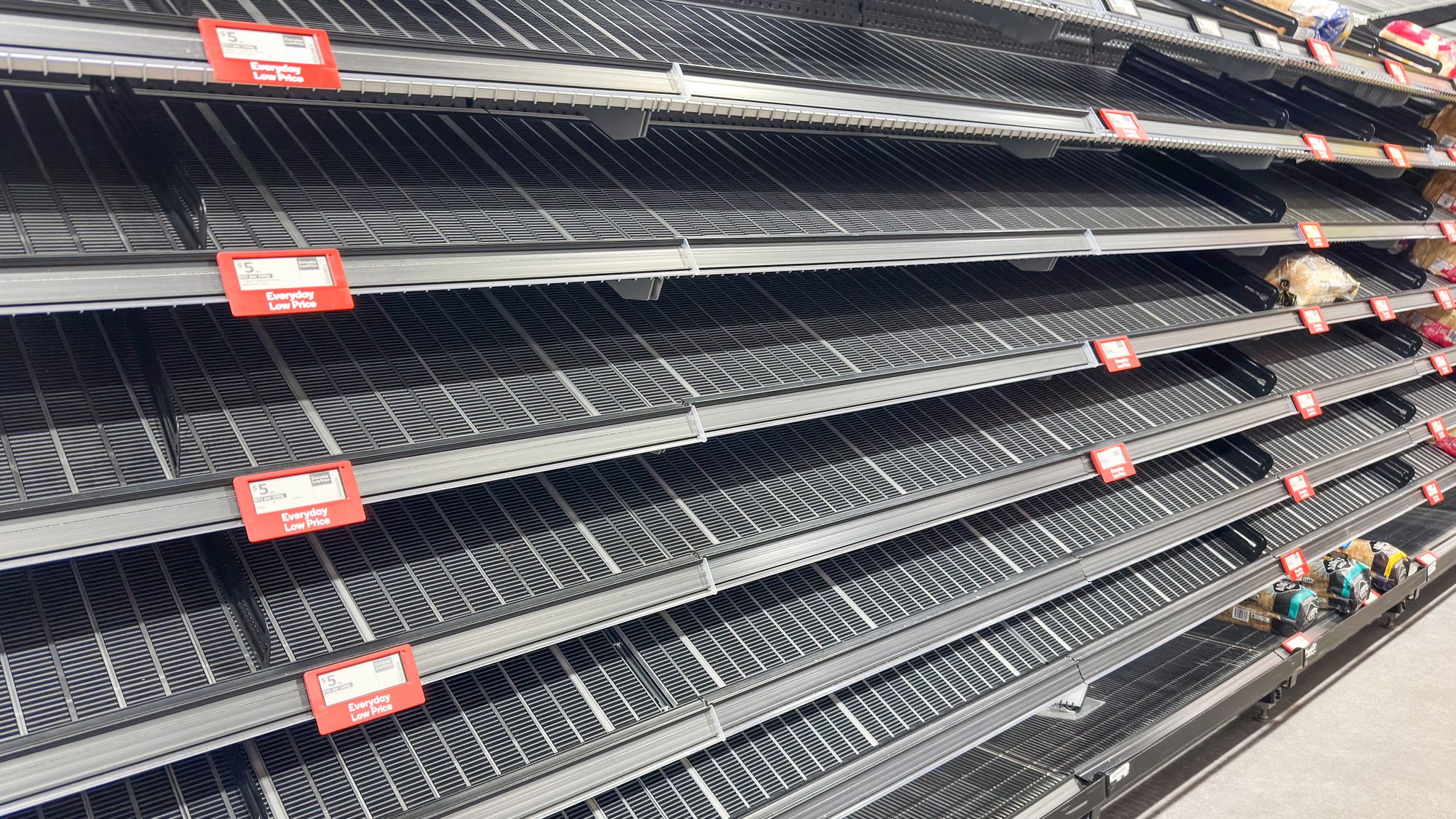
We've seen how quickly public behavior can shift during crises. During the COVID-19 pandemic, panic buying led to widespread shortages of everyday items like toilet paper — in part creating the very problem people feared.
The report suggests similar behavior could occur during an extreme space weather event. As warnings of potential disruptions — such as power outages — spread, people may rush to stockpile essentials like food, fuel and water.
Even without direct damage to supply chains, the surge in demand alone could lead to shortages and long wait times, demonstrating how human behavior can worsen the overall impact of a crisis.
Rising public disorder
Public response to government action during emergencies is not always uniform.
While some people view measures as necessary and protective, others may see them as excessive or unfair. The report warns that similar tensions could emerge during a severe space weather event.
For example, in the even of widespread power outages, perceived inequalities in how power is restored, with some regions prioritized over other could trigger public frustration. In extreme cases, this could act as a "major catalyst for protests", particularly if communities feel they are being treated unfairly.
Power Outage in Almada, Portugal during Iberian Peninsula blackout 2025 which many had speculated was caused by space weather, but this was not the case. (Image credit: mzabarovsky via Getty Images)
Religious and extreme belief responses
The report also explores a lesser-known concept: Millenarianism — the belief that a major event could trigger the end of the world or a profound societal transformation.
In the context of extreme space weather, some individuals or groups may interpret such an event as an impending apocalypse.
History provides sobering examples. In 1997, members of the Heaven's Gate cult died by suicide following the appearance of Comet Hale-Bopp. In 1994, members of the Order of the Solar Temple died in a series of tragic events in Switzerland.
While such cases are rare and difficult to predict, the reprot raises concerns that extreme space weather — particularly if widely misunderstood — could trigger similar reactions among vulnerable groups. In today's digital world, where ideas spread rapidly online, the boundary between fringe beliefs and large communities can become blurred.
A link between technology and behavior
A key takeaway from the summary of space weather worst-case environments is that the impacts of extreme space weather cannot be separated into purely technological or purely human effects — the two are closely linked.
Disruptions to infrastructure can influence behavior, while human reactions can, in turn, amplify the overall impact of an event.
Improving resilience means addressing both sides of the equation. Strengthening infrastructure is essential, but so is improving public understanding of space weather and how it affects our lives.
In a world increasingly shaped by both technology and information, even small steps — like sharing accurate knowledge — can help reduce the risks. If you are reading this, perhaps you could contribute to the cause by telling a friend or family member about space weather!
 Ryan FrenchContributor
Ryan French is a solar physicist, science communicator and author. He is pursuing the mysteries of the sun at the forefront of modern solar physics research, using cutting-edge telescopes on the ground and in space. Ryan also works to share the wonders of the sun and space with the public, through public talks, television, and social media. Ryan's new book, "Space Hazards" is available now.
View MoreYou must confirm your public display name before commenting
Please logout and then login again, you will then be prompted to enter your display name.
Logout MORE FROM SPACE... 1SpaceX launches two Starlink satellite groups 19 hours apart
- 2NASA's Artemis 2 moonshot was just the 'opening act' for America's return to the moon, space agency chief says
- 3The 10 best Stargate SG-1 episodes, ranked
- 4NASA's Artemis 2 moon shot just landed on Saturday Night Live — space toilet jokes and all (video)
- 5Scientists use rare 'Einstein Cross' to learn about young galaxy with surprisingly old stars


