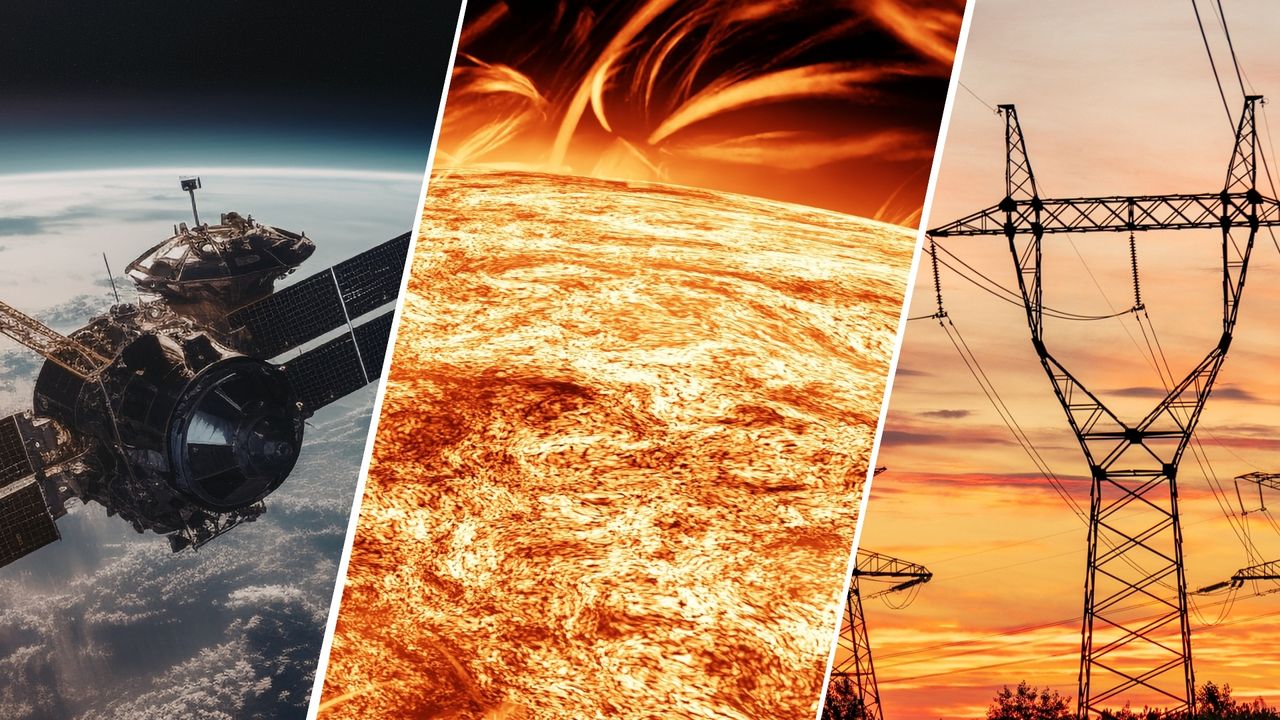
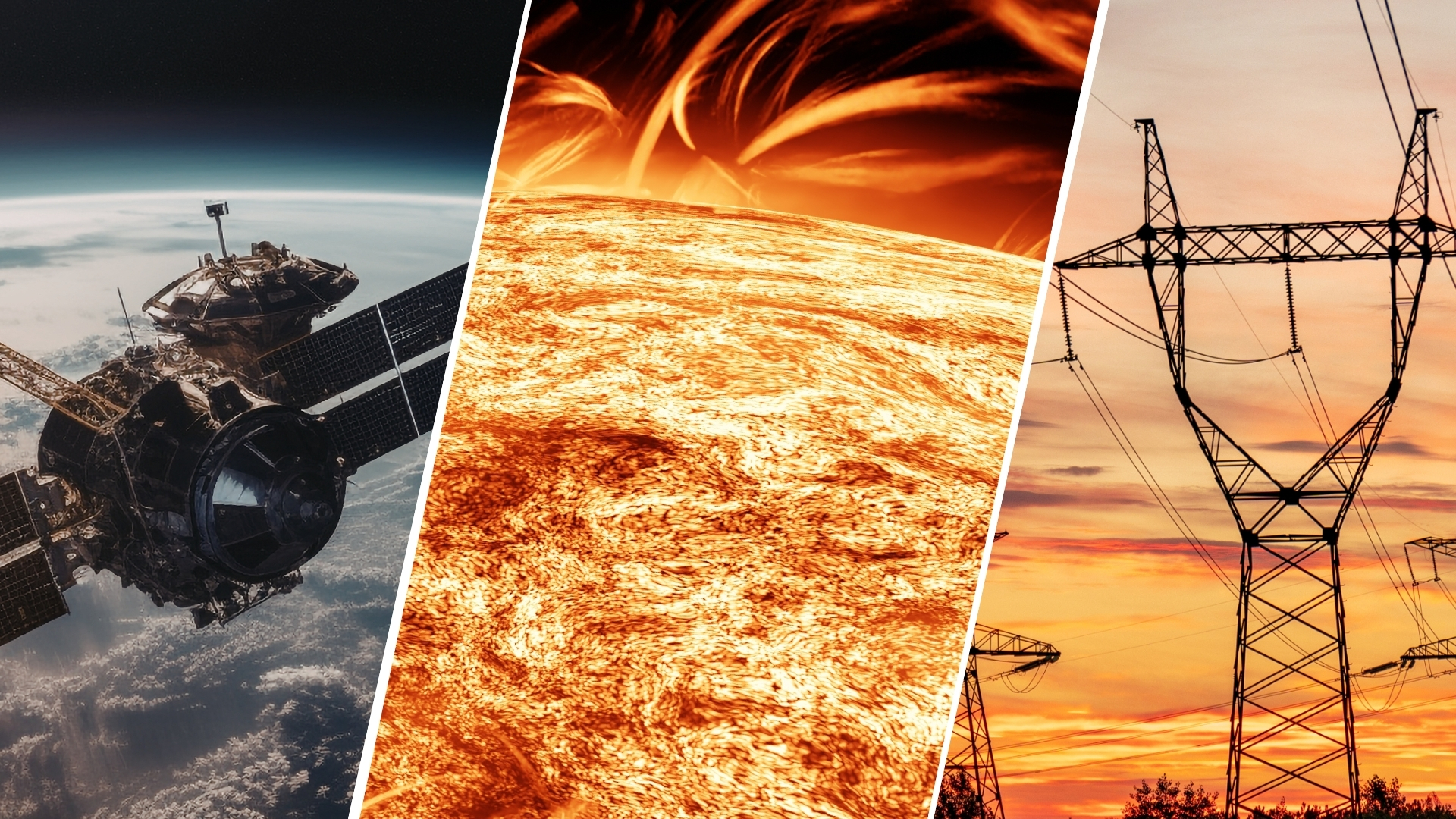
 Scientists outline how a once-in-a-century solar storm could disrupt the technology modern society depends on. (Image credit: Created in Canva Pro) Share this article 0 Join the conversation Follow us Add us as a preferred source on Google Newsletter Get the Space.com Newsletter
 Breaking space news, the latest updates on rocket launches, skywatching events and more!
Contact me with news and offers from other Future brands Receive email from us on behalf of our trusted partners or sponsors By submitting your information you agree to the Terms & Conditions and Privacy Policy and are aged 16 or over.You are now subscribed
Your newsletter sign-up was successful
Want to add more newsletters?
An account already exists for this email address, please log in. Subscribe to our newsletterFor many of us, checking the weather is part of daily life. But, in an increasingly technology-dependent world, there is another kind of forecast we can't afford to ignore: space weather.
Space weather refers to activity on the sun and how it affects Earth and the space around it, a complex, chaotic system scientists are working to understand, forecast and mitigate.
We have experienced several strong space weather events over the past few years, with the strongest in May 2024. During this period, a loss of satellite navigation resulted in a $500 billion loss to the U.S. agricultural industry. This was the strongest space weather event since October 2003, when Sweden and South Africa experienced widespread power outages. But what would a worst-case scenario look like?
In January 2026, a technical report from the U.K.'s Science and Technology Facilities Council (STFC) set out to answer this question in the fourth edition of: Summary of space weather worst-case environments. The document covers all terrestrial impacts of space weather (not including outer space operations), spanning 80 pages.
But what do we mean by 'worst-case scenario'? In reality, it is not worthwhile planning for events that might happen once every million years. Instead, scientists and policy makers consider a 'worst-case' space weather event to be the type of event we might experience every 100-200 years. The report outlines how a worst-case space weather event over this timescale could affect everything from power grids to satellites. Although the scenarios are based on conditions in the U.K., similar impacts could be felt in other parts of the world — especially at similar latitudes.
Space weather can impact a range of technology both on and off Earth. (Image credit: NASA's Scientific Visualization Studio)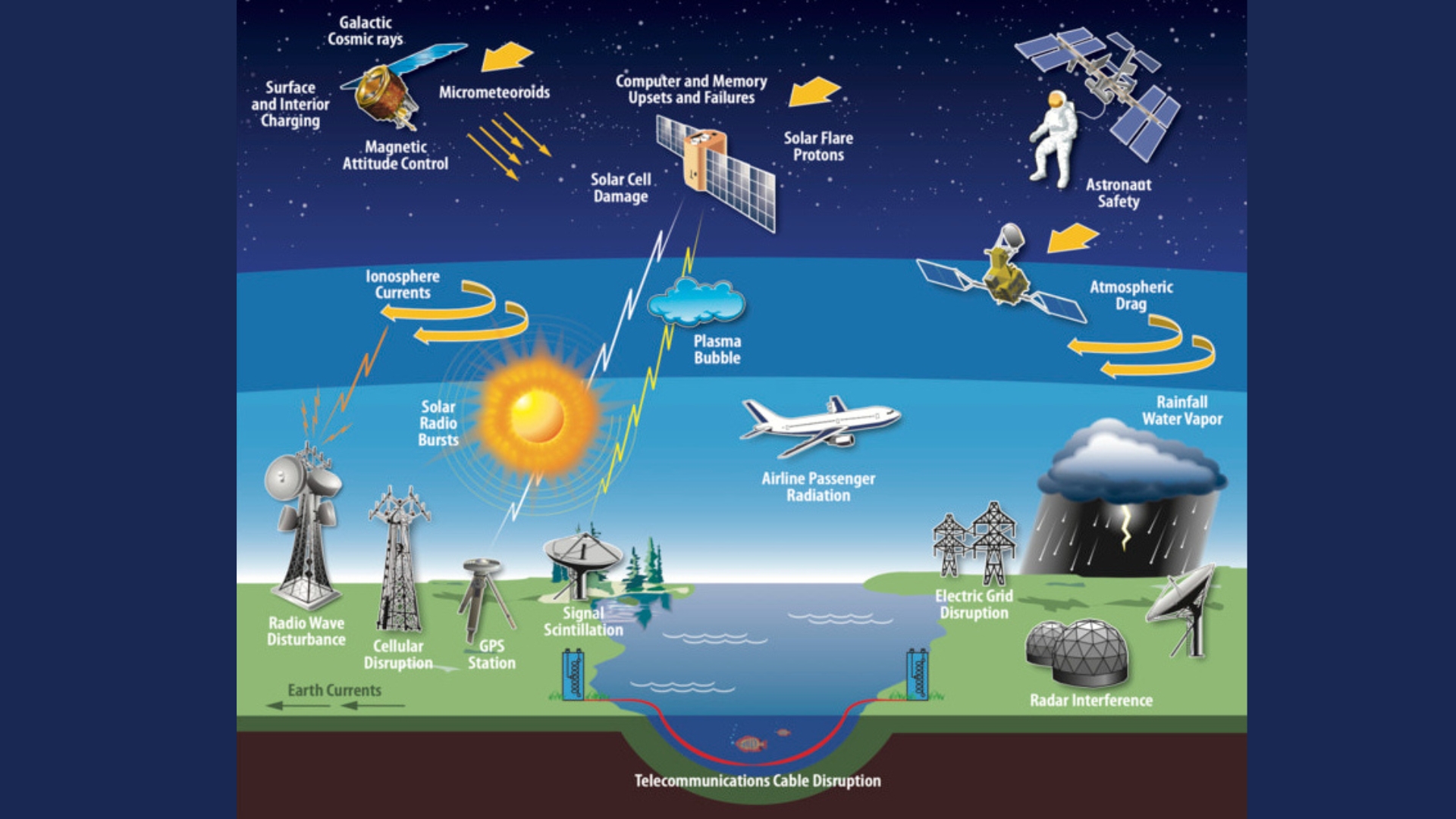
Could space weather knock out power?
During geomagnetic storms, additional electric currents are created in power lines on the ground. If the additional electric currents, plus those already flowing through the system, are strong enough, then they can trip power grid safety systems and potentially lead to regional power outages. The report also explains how this process can cause direct damage and premature aging of transformers, lowering the grid capacity in the months (or even years) after the space weather event.
Get the Space.com NewsletterContact me with news and offers from other Future brandsReceive email from us on behalf of our trusted partners or sponsorsSatellites at risk
According to the report, one of the most immediate impacts of a severe space weather event would be felt in orbit. Satellites, which underpin everything from GPS to weather forecasting, are particularly vulnerable to both radiation and changes in Earth's atmosphere.
During an extreme space weather event, bursts of charged particles can damage onboard electronics and gradually degrade solar panels, shortening a spacecraft's lifespan by years. In the most severe cases, some satellite systems could fail permanently.
The report also highlights another disruptive effect of solar flares, whereby Earth's atmosphere can temporarily expand when heated by incoming X-rays from the sun. That increase in atmospheric drag can slow satellites down, causing them to lose altitude and potentially burn up above us.
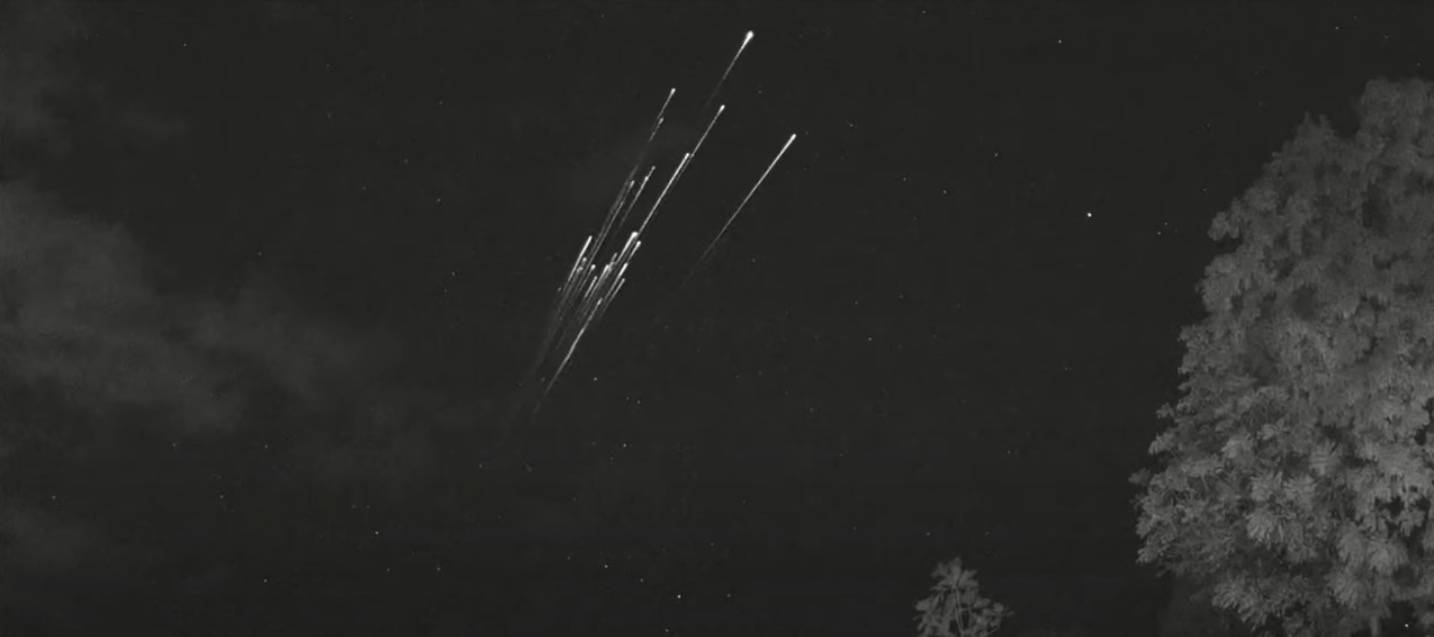
We've already seen a version of this in recent years. Following heightened solar activity in 2022, up to 40 Starlink satellites re-entered Earth's atmosphere after launching during a solar flare. A worst-case scenario would amplify this effect, making it harder for operators to track spacecraft and space debris.
When signals fail
As you read this, radio signals are traveling through and around you. Our society relies on these signals, used in satellite navigation, mobile phone networks, WiFi, communication with flights and ships, and so on. Many of these systems will be disrupted during the worst-case space weather events.
Solar flares themselves produce radio waves, which can 'drown out' radio signals used on the ground. Systems reliant on detecting weak radio signals will be particularly at risk, including radar and global navigation systems. This will be a short-term effect, lasting around an hour on the daylit side of the Earth.
Many radio signals travel long distances by bouncing off a region of the upper atmosphere called the ionosphere. During geomagnetic storms, this layer becomes unstable, disrupting those signals. This can lead to widespread degradation and potential loss of satellite-based navigation and communications for several days. Many systems rely on satellite navigation in surprising ways, such as the US agricultural industry, which was impacted hard during the May 2024 extreme geomagnetic storm.
Radio communication in "Ultra-High Frequency" (UHF) and "Very-High Frequency" (VHF) ranges will also be disrupted for several days. These frequencies will not disrupt your mobile phone, but will interfere with the long-range communication systems used for planes and ships, likely leading to the grounding of flights. This grounding of flights is not necessarily a bad thing, as the report also discusses the risk of hazardous radiation exposure to aircrew, with a higher risk at higher latitudes. Aircrew may need to limit future radiation doses by limiting future flight duties, with pregnant crew particularly vulnerable.
While extreme space weather is unlikely to trigger a doomsday scenario, it could still have serious consequences for modern infrastructure.
The good news? Our ability to monitor the sun and forecast solar storms is improving, giving us more time to prepare for the next big event.
 Ryan FrenchContributor
Ryan French is a solar physicist, science communicator and author. He is pursuing the mysteries of the sun at the forefront of modern solar physics research, using cutting-edge telescopes on the ground and in space. Ryan also works to share the wonders of the sun and space with the public, through public talks, television, and social media. Ryan's new book, "Space Hazards" is available now.
View MoreYou must confirm your public display name before commenting
Please logout and then login again, you will then be prompted to enter your display name.
Logout MORE FROM SPACE... 1From spa to boat party: 10 epic events for the Aug. 12, 2026, total solar eclipse in Spain and Iceland
- 2'The most special thing that will ever happen in my life': Artemis 2 astronauts describe their epic moon mission
- 3This Week In Space podcast: Episode 205 — All About Artemis
- 4SpaceX launches huge 'Cygnus XL' cargo ship carrying over 5 tons of supplies to ISS astronauts (video)
- 5Artemis 3 and beyond: What's next for NASA after Artemis 2 moon success