

 BBC
BBCMillions of voters will head to the polls on Thursday 7 May, for the biggest set of elections since the 2024 general election.
Voters in Scotland and Wales will elect representatives to their national parliaments, while a number of local council and mayoral polls will take place in England.
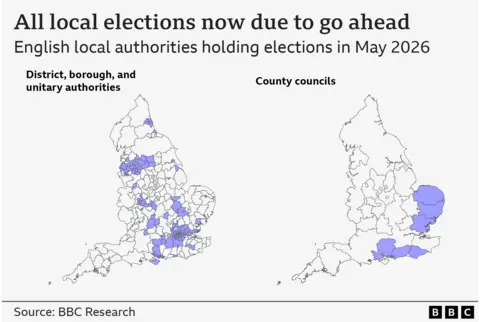
This includes elections in 30 English councils that will now go ahead after the government abandoned previously-announced plans to delay them.
In Northern Ireland, local council and Assembly elections are scheduled for May 2027.
Which elections are taking place in England on 7 May?
Around 5,000 seats across 136 local councils will be up for grabs, after the government U-turn on council election delays.
While polls were set to go ahead in 106 areas, ministers had granted 30 authorities permission to postpone their elections until May 2027. This included five areas where they had already been put back from May 2025.
But in February, the government said elections would now go ahead in these areas this May, following legal advice in the wake of a challenge from Reform UK.
Local election administrators have warned that councils will face "an uphill struggle" to be ready in time.
Ministers had previously said that postponing the polls would help deliver a major shake-up of local government. The two-tier system of district and county councils that exists in many parts of England will be replaced with new "unitary" councils.
The delay had been criticised by opposition parties, whilst the Electoral Commission - which oversees UK elections - had warned it risked "damaging public confidence".
Six mayoral contests will also run on 7 May - in Croydon, Hackney, Lewisham, Newham, Tower Hamlets and Watford.
Elections to select new mayors in Cumbria and Cheshire & Warrington have been postponed until 2027, whilst polls to pick new mayors in Greater Essex, Norfolk and Suffolk, Hampshire and the Solent, and Sussex and Brighton, have been pushed back until May 2028.
In council elections, voters generally have one vote for each available seat in an election area - known as a ward or division.
As in general elections, the first past the post system means whoever receives the most votes wins.
Councils are responsible for local services including care for the elderly and disabled, rubbish collection and recycling, housing, education and road maintenance.
Many councils face a funding crisis and have cut services while increasing council tax.
Government abandons plans to delay 30 council elections
Councils face 'uphill struggle' to be ready for local elections
BBC Verify: What is happening to your council tax in April?
Which elections are taking place in Scotland on 7 May?
The Scottish Parliament election will decide who governs the country in key areas such as health and education and, as a result, the direction it takes on many issues.
All 129 Members of the Scottish Parliament (MSPs) are up for re-election.
There are 73 constituency MSPs, and 56 regional MSPs (seven per region) in Holyrood.
Each voter has two ballot papers and casts two votes, one to elect their constituency MSP and one to elect their area's regional MSPs.
Constituency MSPs are selected directly under first past the post, with the winner being the candidate who receives the most votes.
The process to select regional MSPs uses a type of proportional representation.
Voters choose either a political party or an individual candidate from a list. Political parties are allocated regional seats according to a formula which includes the number of votes they receive in each region and the number of constituencies they win outright.
Usually the party with the most MSPs forms the Scottish government, and its leader becomes first minister.
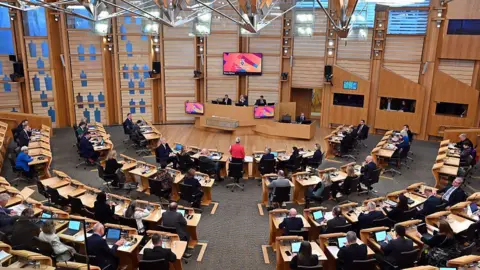 Getty ImagesDesigned by Catalan architect Enric Miralles, the Scottish Parliament building was officially opened by Queen Elizabeth II in October 2004
The current Scottish Parliament was set up in 1999, when Scotland already had its own legal and education system.
Holyrood is now responsible for a much broader range of issues including health, housing, policing and prisons, as well as many aspects of transport, welfare and tax.
It can pass laws in any areas not "reserved" to the UK parliament at Westminster.
Scottish Parliament election to have daytime vote count
Scotland's main election issues in six charts
Why independence is still a political dividing line in Scotland
Sir John Curtice: Which issues will decide the elections in Scotland and Wales?
Which elections are taking place in Wales on 7 May?
The 2026 Senedd election represents the biggest change to the parliament since powers began to be transferred to Wales in 1999. It will determine who governs Wales on many key issues.
The number of Members of the Senedd (MSs) will be expanded from the current 60 to 96 representatives from 16 newly devised constituencies.
Political parties can list up to eight candidates for each constituency. Independent candidates can also stand. Voters choose one party or one independent candidate.
The 96 seats will then be allocated according to the share of votes received by each party or independent candidate.
The party that wins the most seats in the Senedd election would expect to lead the government. However, no party has ever won a majority in the Welsh Parliament and the new system makes it highly unlikely that will change at this election.
Any MS can nominate any member to be first minister. If there are two or more candidates, MSs will vote to decide who they want to fill the role.
 Getty ImagesDesigned by architect Richard Rodgers, the Senedd building was officially opened on St David's Day in 2006
The National Assembly for Wales opened in 1999.
Renamed Senedd Cymru or Welsh Parliament in 2020, its responsibilities now include health, schools, transport and farming, as well as some tax powers.
What does the Senedd do?
What's your Senedd constituency?
Senedd prepares for 'once in a century change' - but do voters know?
How can I vote in the May elections?
There are three ways to vote:
- in person at your local polling station on election day between 0700 BST and 2200 BST
- by postal vote
- by nominating someone to vote on your behalf - a proxy
You must be 18 to vote in the local elections in England, or 16 to vote in the Scottish Parliament and Senedd elections.
In all cases you must be registered at an address in the area where you want to vote.
You must be either a British or Irish citizen, or a qualifying foreign national - the rules vary according to which country you are from and the type of election.
People in four parts of England will be able to vote in different places or ahead of polling day, as part of a pilot exploring ways to make it easier to participate in elections.
Voters in Milton Keynes will be able to cast their ballot in the centre:mk shopping centre. Voters in Cambridge, North Hertfordshire and Tunbridge Wells will be able to vote in person in a variety of locations in the days running up to 7 May, including the previous weekend.
What photo ID will you need to vote in the May elections?
Selfies, dogs, clothes, kids and drinking: What can't you do in a polling station?
What is the deadline for registering to vote?
To vote in person on 7 May, you must be on the electoral register by 23:59 BST on Monday 20 April.
You can register online with your National Insurance number, or by writing to your council's electoral registration office.
The rules about postal and proxy votes have changed, and you need to renew them every three years. Any postal or proxy votes set up before 31 October 2023 have expired.
If you are already registered, the deadline to request a postal vote is 17:00 BST on Tuesday 21 April.
If you are already registered, the deadline to apply for a proxy vote is 17:00 BST on Tuesday 28 April.
Electoral Commission: Register to vote
Electoral Commission: Apply for a postal vote
Electoral Commission: Apply for a proxy vote
Find your polling station
What ID do I need to vote?
You do not need ID to vote in person in the Scottish Parliament or Senedd elections on 7 May.
Everyone voting in person in the local elections in England will need valid photo ID, such as a passport or driving licence.
You can use out-of-date ID as long as you are still recognisable.
Anyone who is already registered to vote but doesn't have the correct ID - or who no longer looks like their photo - can apply for a free voter authority certificate.
The deadline to apply for one for the May elections is 17:00 BST on Tuesday 28 April.
England local elections 2026Welsh Parliament election 2026Scottish Parliament election 2026UK elections 2026Local government


