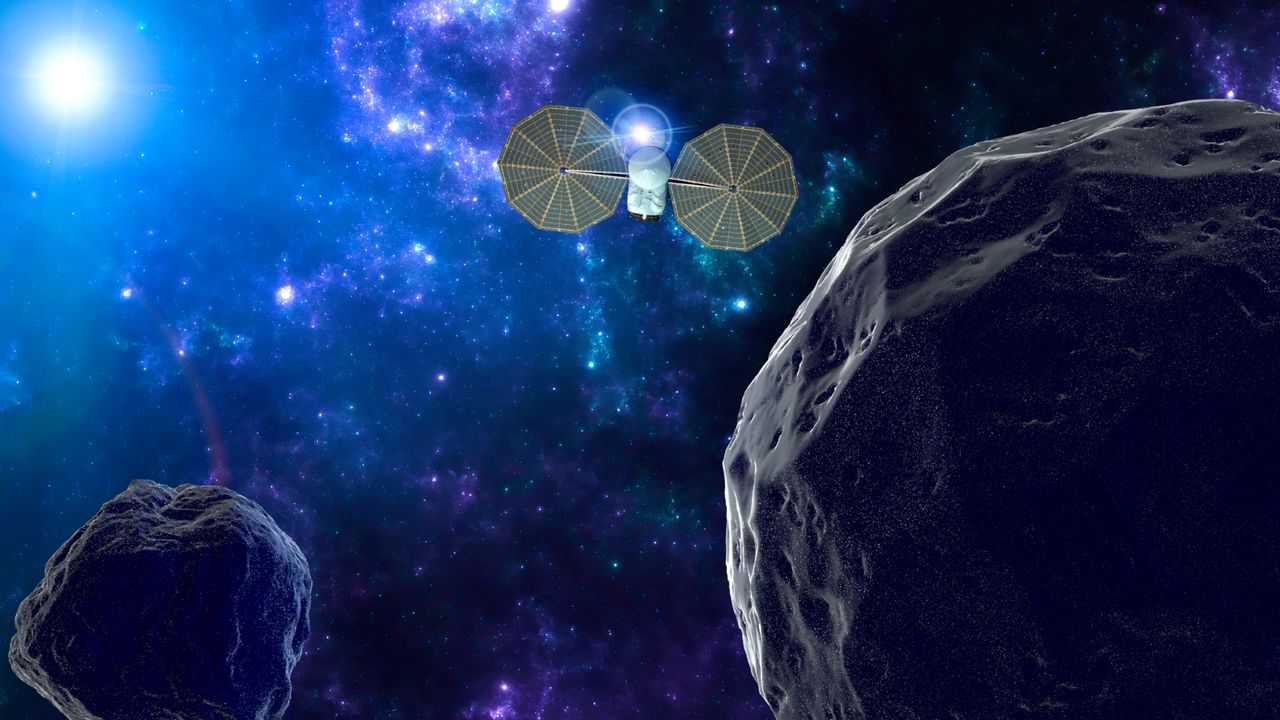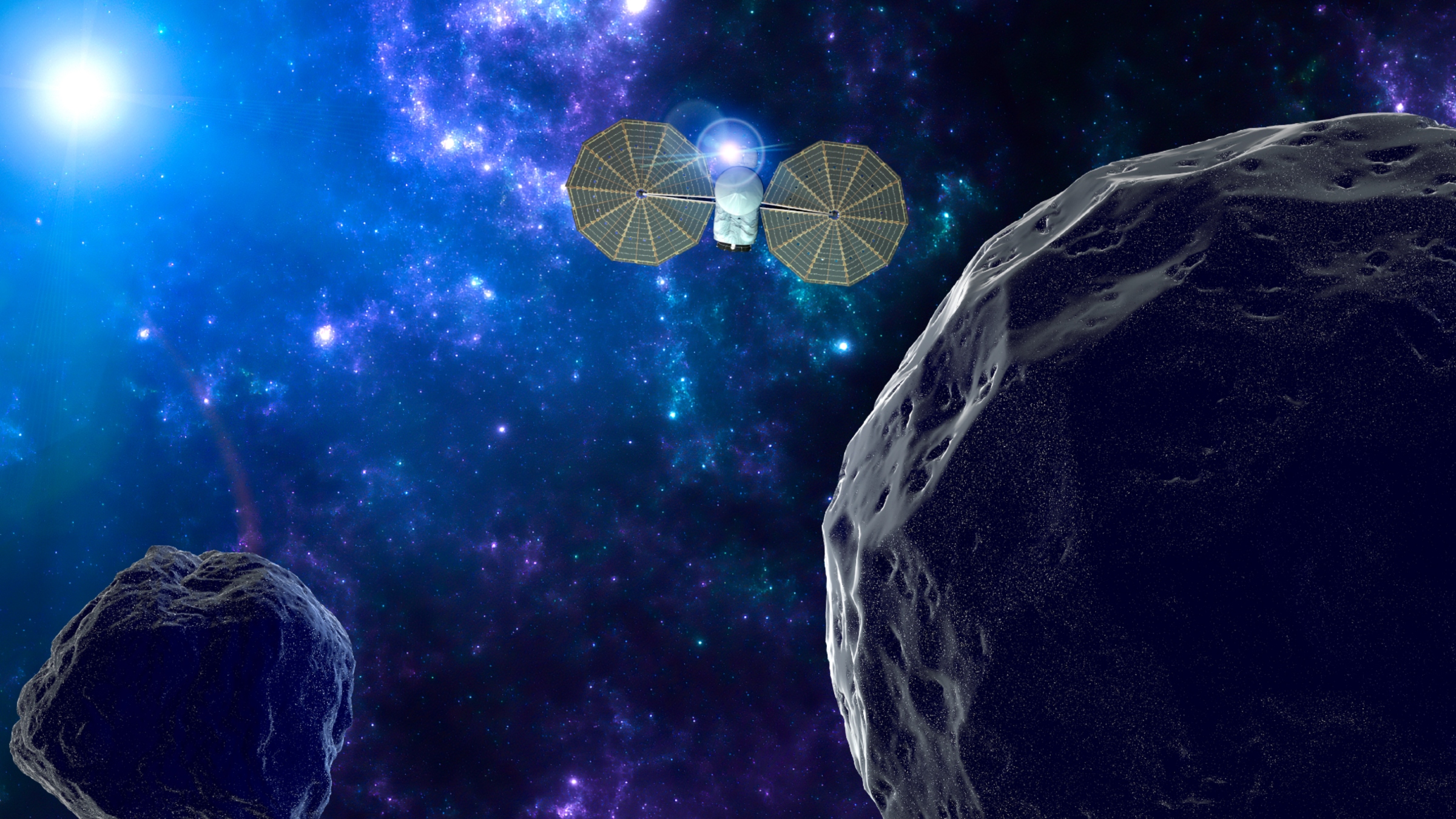
China's Tianwen-2 probe, which bears a striking resemblance to NASA's Lucy spacecraft (pictured in this illustration), has arrived at Earth's quasi-moon Kamo'oalewa and will soon attempt to land on the mysterious space rock. (Image credit: Naeblys via Getty Images)
Share this article Join the conversation
Follow us Add us as a preferred source on Google Newsletter Subscribe to our newsletter
A Chinese spacecraft has arrived at one of Earth's temporary "quasi-moons" and will soon attempt to land on the space rock to scoop up samples that will be returned to our planet next year. The ambitious mission could help researchers uncover secrets about Earth's main moon and provide clues that may benefit space exploration and planetary defense, experts say.
The Chinese National Space Agency (CNSA) probe, named Tianwen-2, launched from Xichang Satellite Launch Center in southern China on May 28, 2025, Live Science's sister site Space.com reported at the time. The car-sized spacecraft sent back its first images a few weeks later, giving us our first glimpse of its secretive design, followed by a selfie with Earth a few months later.
The mission's primary target is 469219 Kamo'oalewa — also known as 2016 HO3 or simply Kamo'oalewa — a near-Earth asteroid discovered in 2016 by astronomers at Hawaii's Haleakala Observatory. It likely spans somewhere between 130 and 330 feet (40 to 100 meters) across and is a "quasi-satellite" of our planet, meaning it's orbiting the sun right alongside Earth in a temporary partnership. (Kamo'oalewa means "oscillating celestial fragment" in Hawaiian.)
Tianwen-2 is predicted to have arrived at Kamo'oalewa on June 7 and inserted itself into an orbit alongside the asteroid, according to an unverified timeline shared by freelance journalist Andrew Jones, a leading expert on China's space program. Around a month later, on July 4, the probe is expected to descend upon the space rock to collect samples from its surface, potentially employing a never-before-seen drilling technique to do so. (The CNSA has not released an official timeline for the mission or shared any recent updates about its progress.)
If successful, the samples are expected to be returned to Earth on Nov. 29, 2027, according to the same timeline. At this point, Tianwen-2 will then slingshot around our planet and head farther out into the solar system for its secondary mission: to rendezvous with and study 311P/PanSTARRS — a peculiar object beyond Mars, which displays characteristics of both comets and asteroids — in 2035.
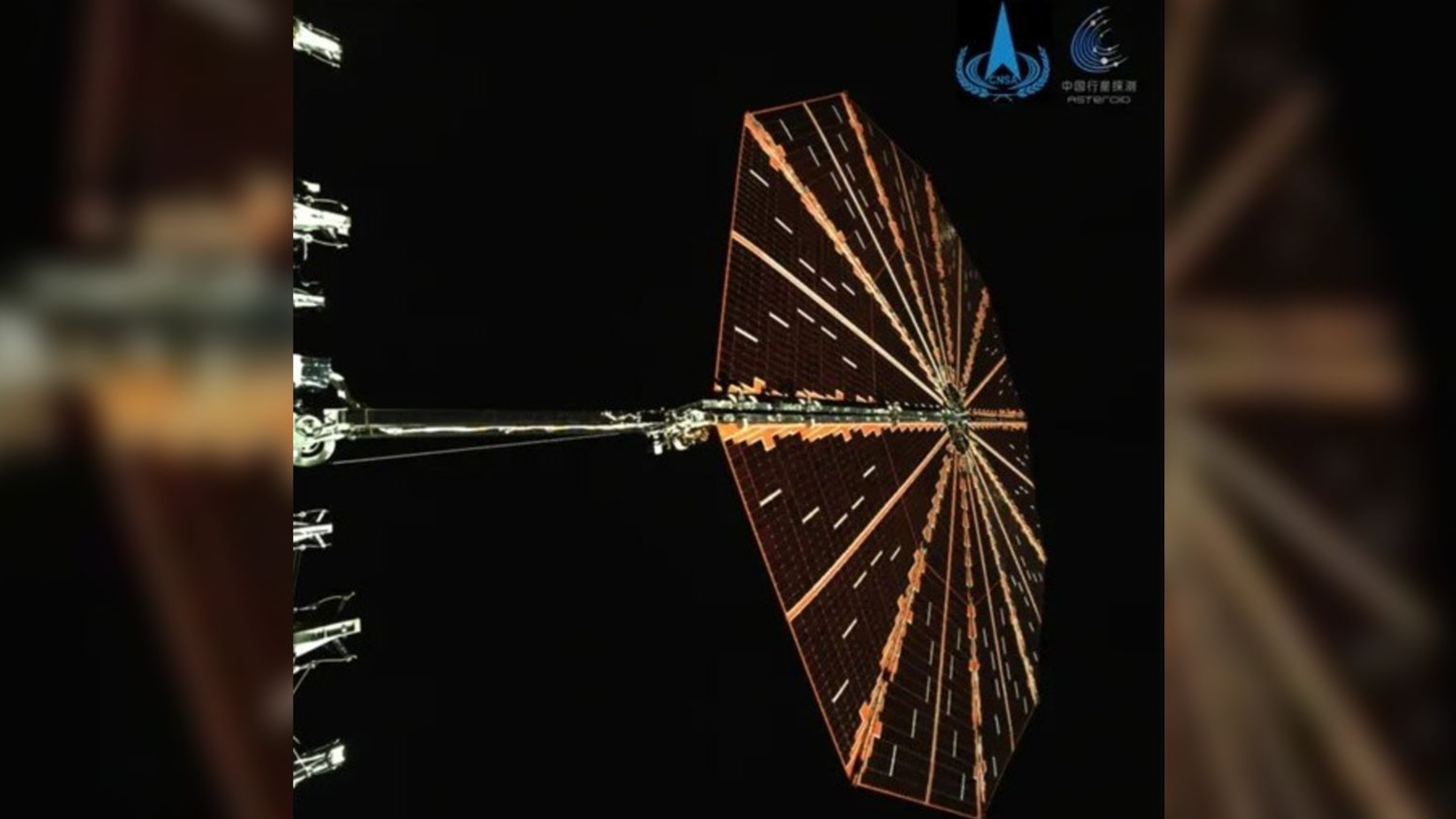
This photo of one of Tianwen-2's decagonal solar panels, captured in orbit, was the first image of the probe released by the CNSA.
(Image credit: CNSA)
Samples from Kamo'oalewa could help answer many interesting questions, including the true origin of the object, which some experts believe may have broken off from the moon.
"What makes [this mission] extraordinary is that we don't yet know [the object's] composition or origin," Li Chunlai, a researcher with the Chinese Academy of Sciences' National Astronomical Observatories and chief commander of Tianwen-2's ground application system, said in a state-sanctioned video translated to English. "We'll only obtain definitive answers after completing our exploration."
Sign up for the Live Science daily newsletter now
Get the world’s most fascinating discoveries delivered straight to your inbox.
Contact me with news and offers from other Future brandsReceive email from us on behalf of our trusted partners or sponsors
What is Kamo'oalewa?
There are currently eight known quasi-moons orbiting the sun alongside Earth, following the most recent quasi-moon discovery in September 2025. Unlike the similarly named "minimoons," which are asteroids that are briefly captured by Earth's gravity for a few months or years at a time, quasi-moons are temporary satellites that slowly circle our planet but are never gravitationally bound to it.
This relationship can last decades, or even centuries. For example, experts think Kamo'oalewa has been accompanying our planet for at least 100 years and could remain alongside it for another 300 years before it starts to fall out of sync with our solar orbit.
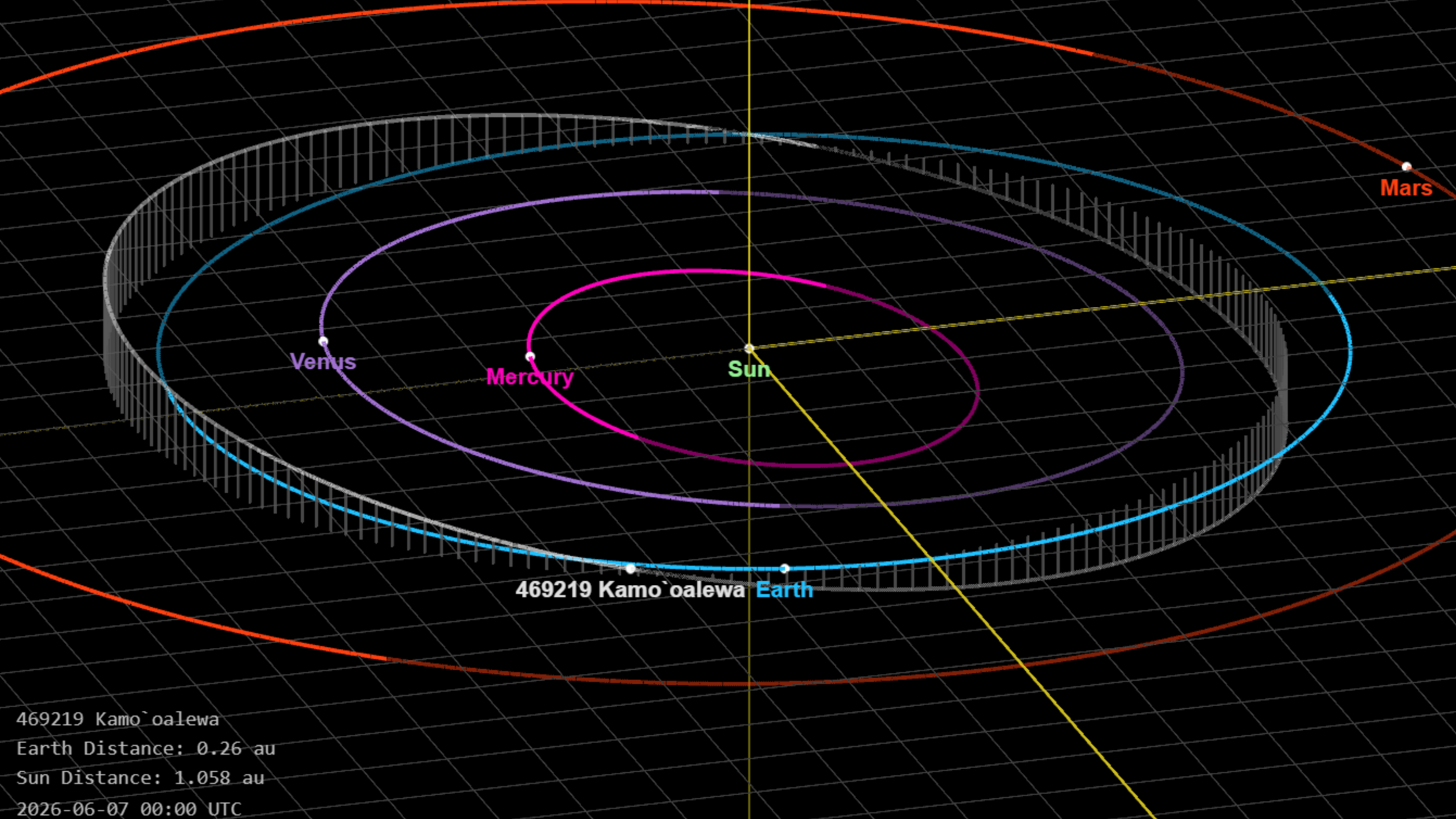
On June 7, when Tianwen-2 was expected to arrive at Kamo'oalewa, the space rock was around 24.2 million miles (39.1 million km) from Earth.
(Image credit: NASA/JPL/Small-Body Database Lookup)
"The way Kamo'oalewa moves with Earth is kind of like a dog that might tag along with you for a while on a long walk through the woods, but it's not your dog," Richard Binzel, a planetary scientist and asteroid expert at MIT, told Live Science in an email.
The Ferris-wheel-size space rock is one of the closest quasi-moons to us, with a minimum distance of around 2.9 million miles (4.6 million kilometers) from Earth, or around 12 times farther away than our actual moon. It is also one of the fastest-spinning quasi-moons, rotating around its axis every 30 minutes. But unlike other quasi-moons, which likely originate from the solar system's main asteroid belt, between Mars and Jupiter, our current best guess is that Kamo'oalewa is actually a piece of the moon.
This hypothesis is based on observations from 2021 that showed Kamo'oalewa absorbs and reflects light similarly to the moon, hinting that the space rock may be a chunk of lunar material ejected by a long-ago meteor strike. More recently, in 2024, researchers narrowed down the most likely impact crater from which the asteroid originated: the 13.6-mile-wide (22 km) Giordano Bruno crater, located on the far side of the moon. However, there is still a chance that Kamo'oalewa is a main-belt asteroid that just happens to look an awful lot like lunar material.
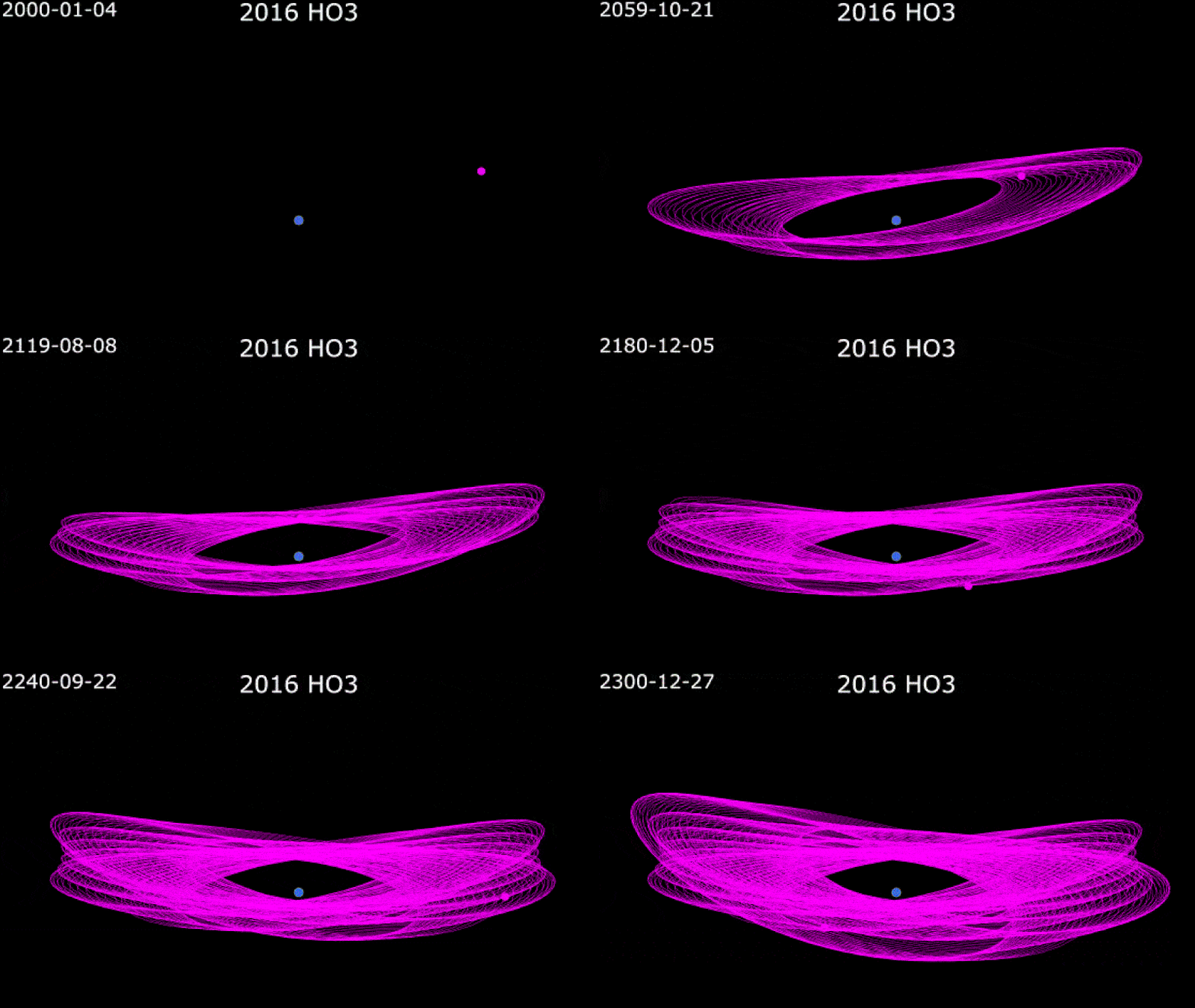
Kamo'oalewa (a.k.a. 2016 HO3) circles Earth but does not orbit our planet. This simulation shows its predicted movements relative to Earth over the next few centuries.
(Image credit: NASA/Pheonix7777/Wikimedia)
"I am curious to find out the answer about its origin, since the debate on its [potential] lunar origin is still very open," Marco Fenucci, a mathematician at the European Space Agency's Near-Earth Objects Coordination Centre who has co-authored multiple studies on Kamo'oalewa, told Live Science. This mission should "definitely give us an answer to this matter," he added.
Scientists are also unsure whether Kamo'oalewa is a "solid monolithic rock," like the $100,000 quadrillion asteroid Psyche (the target of NASA's ongoing Psyche mission), or a "rubble-pile-like asteroid," such as Bennu or Ryugu, both of which have been explored by sample-return missions in recent years, Fenucci said.
Scooping up samples
Having arrived at Kamo'oalewa, Tianwen-2 will spend the next few weeks mapping the asteroid's surface at altitudes between 1,000 feet and 12.5 miles (300 m to 20 km) above its surface, according to limited mission details revealed by Chinese scientists in a January study. The resulting map will allow researchers to estimate the asteroid's density and work out the best landing spot.
On July 4, the probe is expected to swoop down and scoop up around 3.5 ounces (100 grams) of surface material, or regolith, from the asteroid, which is slightly less than what NASA's OSIRIS-REx mission managed to grab from Bennu. However, there are multiple ways this sampling process could play out.
If the asteroid is a pile of rubble, the probe will utilize a touch-and-go approach, which involves hovering just above the surface and using a robotic arm to reach out and grab the sample. This method was also used by OSIRIS-REx for Bennu and by Japan's Hayabusa2 mission, which scooped up samples from Ryugu.
But if Kamo'oalewa has a more solid surface, Tianwen-2 will attempt to land directly on the space rock and anchor itself in place before drilling into the asteroid. This has never been attempted before and could allow for longer contact time and "more controlled sampling," according to The Planetary Society.
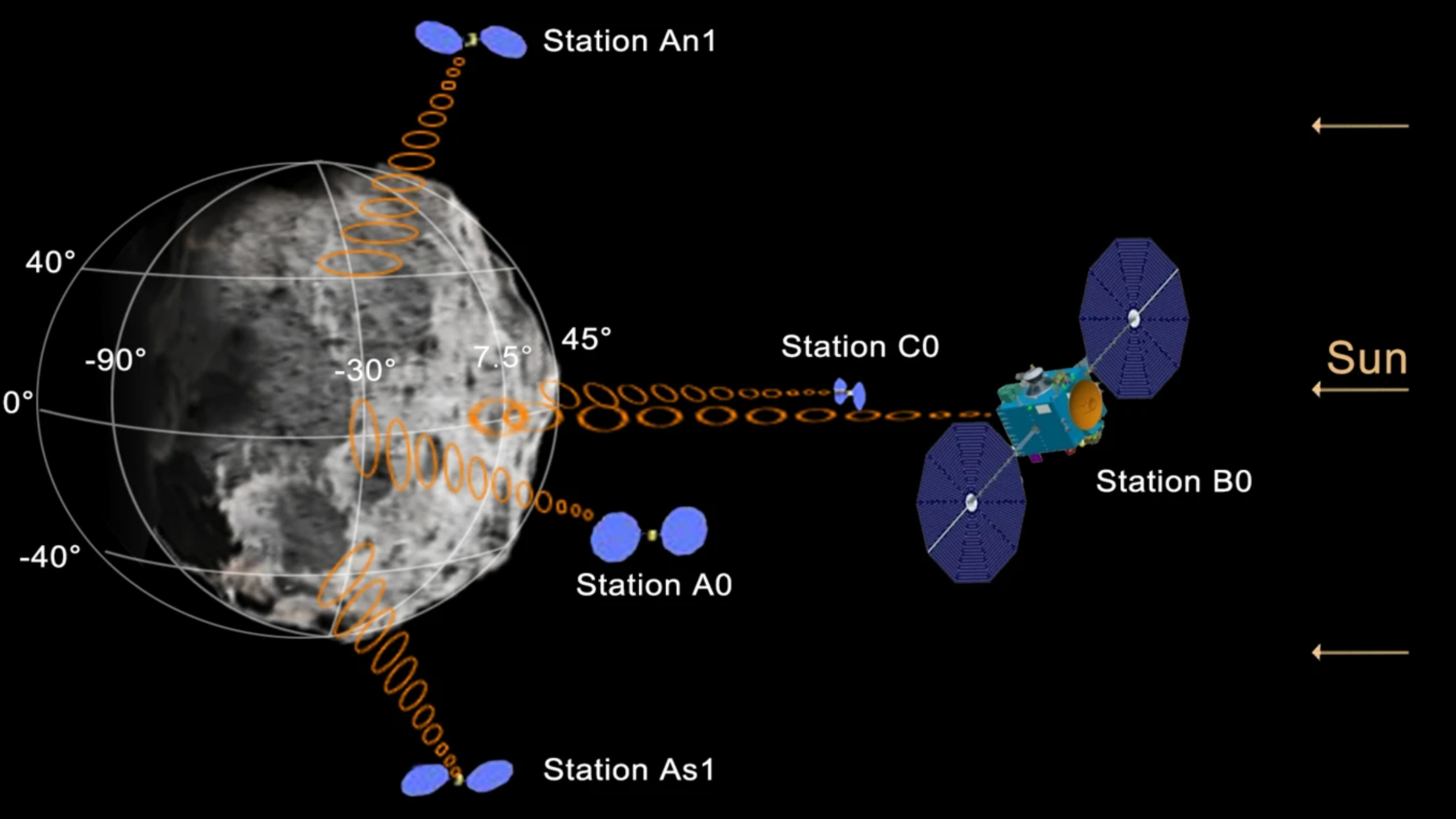
Tianwen-2 will circle Kamo'oalewa at various altitudes in order to scan the space rock and figure out its best possible landing spot.
(Image credit: Zhang et al. 2026)
After collecting samples, the probe will remain alongside the asteroid and conduct further analysis of its size, shape and trajectory.
In late April 2027, Tianwen-2 will depart Kamo'oalewa and begin the six-month journey back to Earth, where it will dump its samples in a return capsule that will fall to our planet's surface as the probe begins its long journey to rendezvous with 311P/PanSTARRS.
The return capsule will reenter Earth's atmosphere at around 27,000 mph (43,500 km/h), researchers wrote in the January study. That's slightly faster than the Orion capsule carrying the Artemis II astronauts traveled as it fell back to Earth in April.
What could we learn from Tianwen-2?
In addition to ending the debate over Kamo'oalewa's origin, samples from Tianwen-2 could reveal more about the solar system and our place within it.
For example, previously returned asteroid samples have helped to "tell us where Earth's water came from, how complex organic molecules were distributed in the early solar system, and how surface processes like space weathering alter asteroid properties over time," Fenucci said. These samples can also be used to "establish a link to known meteorites found on Earth" and help us learn more about these space rocks, he added.
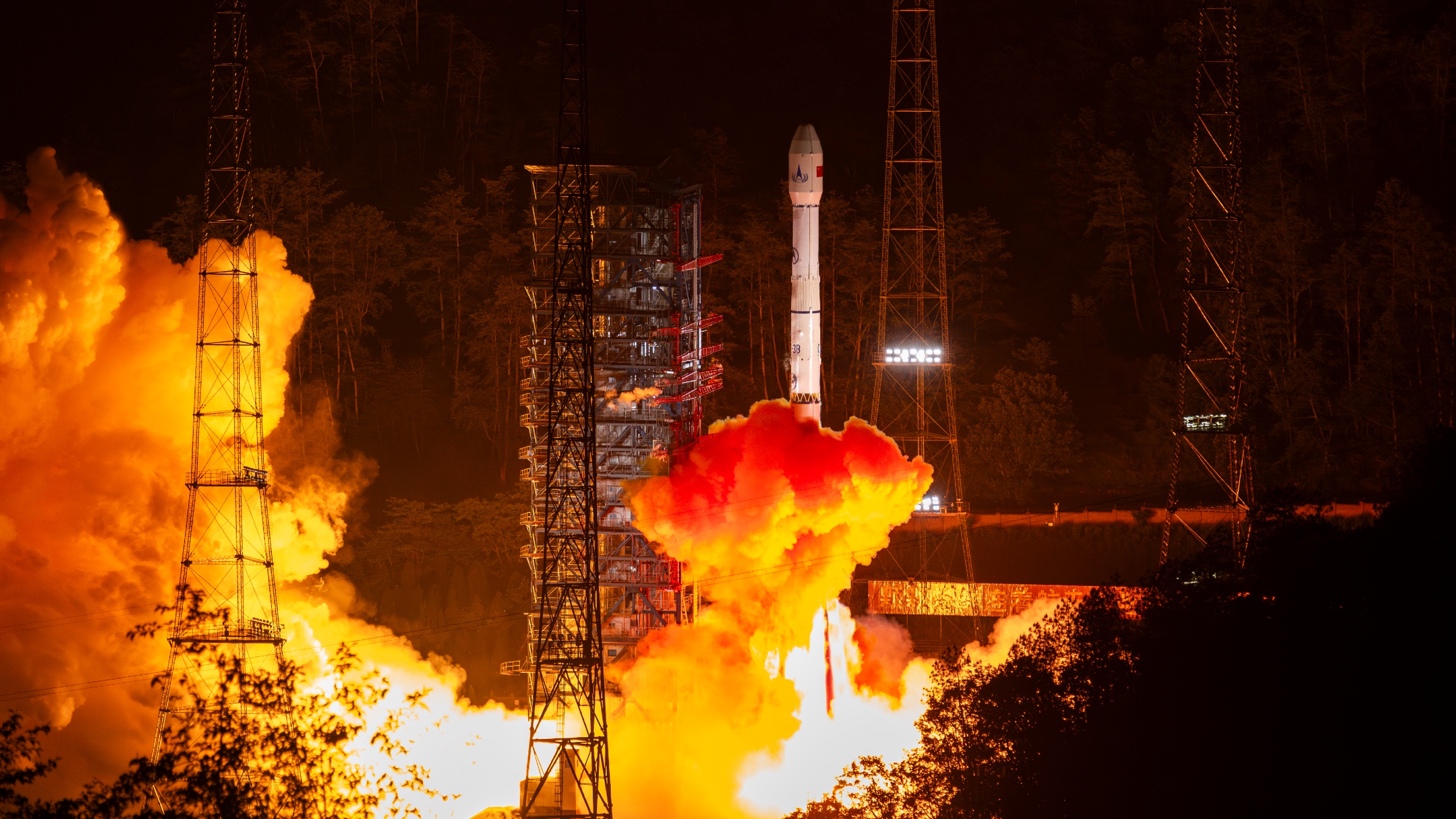
Tianwen-2 launched into space May 28 on board one of China's Long March 3B rockets.
(Image credit: VCG/VCG via Getty Images)
The proximity of quasi-moons and minimoons to Earth also makes them valuable assets for future space exploration missions. Some researchers have proposed using them as temporary bases or refueling stations that could serve as stops on the way to Mars or other faraway destinations. These objects "could become literal stepping stones for human missions to practice what it is like to leave the Earth-moon cradle," Binzel said.
RELATED STORIES
One particular idea that scientists want to explore is whether water can be extracted from these objects. And if Kamo'oalewa is a piece of the moon, that could have implications for NASA's planned moon base. "Someday, it might be possible to extract that water to provide resources for thirsty astronauts or even generate usable rocket fuel from the hydrogen," Binzel said.
Some near-Earth objects also pose a potential risk to our planet. And while Kamo'oalewa will likely never hit us (and would probably only cause localized damage if it did), there are much larger nearby space rocks that could trigger global catastrophes if they were to impact our planet.
"Over the time scale of centuries, these kinds of objects have a chance of striking the Earth," said Binzel, who invented the Torino scale used to measure the impact potential of near-Earth objects. Therefore, a better understanding of space rocks like Kamo'oalewa "can prepare us in how to deal with a threatening object if one were ever discovered," he added.
Finally, this mission will likely provide another opportunity to assess China's space exploration capabilities, which could hint at whether the country could overtake the U.S. as the top nation in space, as some experts predict.
TOPICS
 Harry Baker
Senior Staff Writer
Harry is a U.K.-based senior staff writer at Live Science. He studied marine biology at the University of Exeter before training to become a journalist. He covers a wide range of topics including space exploration, planetary science, space weather, climate change, animal behavior and paleontology. His recent work on the solar maximum won "best space submission" at the 2024 Aerospace Media Awards and was shortlisted in the "top scoop" category at the NCTJ Awards for Excellence in 2023. He also writes Live Science's weekly Earth from space series.
View More
You must confirm your public display name before commenting
Please logout and then login again, you will then be prompted to enter your display name.
Logout