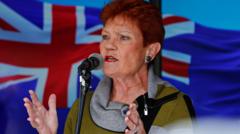

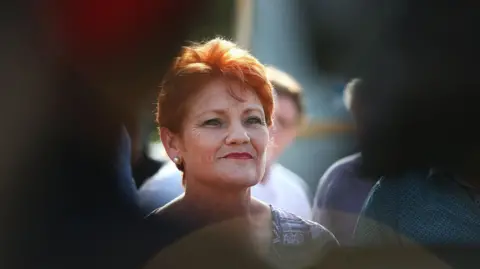
 Getty ImagesPauline Hanson, founder and leader of Australia's right-wing populist One Nation party
Thirty years ago, against the odds, a fish-and-chip shop owner with little political experience won a seat in the Australian parliament.
Since then Pauline Hanson has become as well known for her inflammatory anti-immigration rhetoric as much as her parliamentary stunts, while support for her right-wing populist One Nation party has ebbed and flowed.
But after returning from the political wilderness a decade ago, Hanson's party is now riding a new wave of popularity, driven by voters weary of mainstream political parties that they say don't understand their struggles.
On 21 March, One Nation achieved its first electoral breakthrough outside Hanson's home state of Queensland. In a state election in South Australia, the party won the second highest number of votes - more than 20% - the first time it has done so in Australia where two parties have traditionally been dominant.
Incumbent Labor Premier Peter Malinauskas won a resounding victory in the poll, increasing his majority in the process, but One Nation will get at least three candidates elected, mostly at the expense of the main conservative opposition Liberal Party.
As the Liberals flounder in Australia, and populism takes hold in other parts of the world, analysts have asked whether this election heralds a move by One Nation from the fringes to the centre of political gravity at a national level.
It's a "very ominous sign" for Australia's two major political parties, former Labor strategist and co-director of polling firm Redbridge, Kos Samaras, tells the BBC.
Housing, cost of living dominate
Since its inception, One Nation has been best known for its anti-immigration policies. In Pauline Hanson's first speech to parliament in 1996, she said Australia was "in danger of being swamped by Asians", a speech which also took aim at Aboriginal and Torres Strait Islander people and set the tone for her approach to politics.
Two years later One Nation appeared ascendant, picking up 11 seats in Queensland's state election and winning 8.4% of primary votes in the federal election.
But it has never been able to repeat, or build on that initial success, hovering in the low single digits since then and getting only a handful of members into Australia's parliaments.
At last year's federal election however their vote share grew to 6.4%. Recent changes in the political climate, a cost-of-living crisis and infighting among the Liberals and their Nationals coalition partners have given it an opportunity. National opinion polls this year showed it in second place to Labor.
The South Australia poll was the first electoral test for this surge in support and the party attracted many voters frustrated with issues like cost of living.
That's what convinced Brittany - a life-long supporter of the conservative Liberal-National Coalition until now - to switch her vote.
"I'm not against migration. We need it," the 36-year-old aged care worker from Adelaide told the BBC.
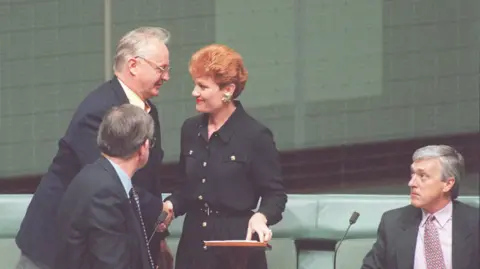 Getty ImagesPauline Hanson after delivering her first speech to parliament in 1996.
Former Labor voter Andrew Sheffield, 68, tells a similar story, suggesting the party he once supported no longer represents working Australians.
"Either buying a house or renting is a ridiculous cost now," Sheffield said. "I have children and grandchildren who have to contend with that."
Facing a popular Labor incumbent and a young, recently selected opposition leader, One Nation campaigned widely, recruiting prominent former Liberal senator Cory Bernardi to lead its ticket, and running candidates in every electorate.
It promised to boost housing supply and cap immigration - though that isn't up to states.
One Nation was never expected to win in South Australia – but as successive federal elections show a long-term trend of voters drifting away from the major parties, its performance was being nervously watched by Labor and the Coalition in Canberra.
The rise of One Nation
"Pauline Hanson was an accident," former prime minister John Howard said in a recent interview with Nine News.
His Liberal Party had originally put Hanson up as a candidate in Queensland, but during the 1996 campaign took her off the ticket for penning an opinion column criticising welfare payments for Aboriginal Australians.
Despite this, Hanson secured one of the biggest swings in the country to win a safe Labor seat.
Within two years, however, she had lost her re-election bid and spent 18 years in political exile, unsuccessfully running in nine state and federal elections until she was elected to the Senate in 2016.
Throughout it all though, she's stayed in the headlines.
In the late 90s she drew attention for a video – Hanson said it was made after she received death threats - in which she announced her assassination, staring at the camera and saying, "If you are seeing me now, it means I have been murdered."
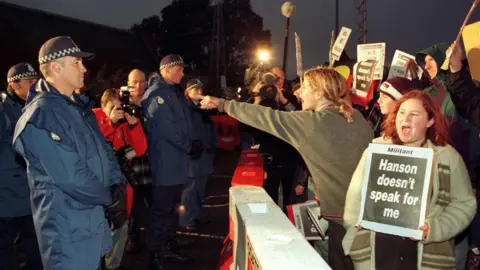 Getty ImagesProtesters in Geelong, Victoria, in the 1990s opposed Hanson's views on race
In 2003 Hanson was briefly jailed for electoral fraud. She denied the charges and the conviction was overturned on appeal.
During her time in the Senate a federal court judge has found that she racially vilified a fellow senator - a decision against which she is appealing. And she has twice worn a burka in the chamber to press for a ban on the garment.
This month she was formally censured for saying there were no "good" Muslims.
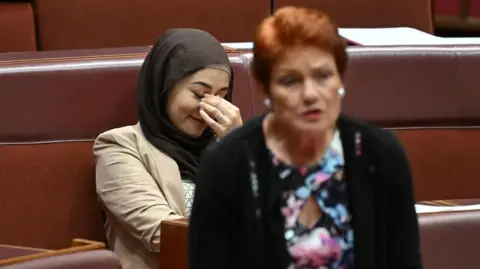 ReutersSenator Fatima Payman reacts during the debate on a censure motion against Pauline Hanson earlier this month
But Hanson's biographer and filmmaker Dr Anna Broinowski says the One Nation leader has endured as a figurehead of right-wing politics because she paints herself as a "person of the people".
She was the first Australian politician to set up a website and blog in the 1990s, allowing her to reach voters directly, Broinowski notes, and last year the party made its own cartoon feature-length film, featuring music by singer and right-wing commentator Holly Valance.
"She has styled herself as the anti-politician, the underdog, who is just like us, who wants to drain the elite 'Canberra swamp'," she tells the BBC.
Hanson says she's been "ridiculed, bashed around and called racist, xenophobic", but says people have now changed their minds.
"It's not just a protest vote," she told Sky News Australia as the results came in on Saturday night.
"There is a movement and there is an undercurrent, and it is people saying we've had a gutful, we want our country back."
Filling a void for 'abandoned' voters
South Australia historically hasn't been a likely hunting ground for One Nation, Kos Samaras says, because it is largely urbanised, middle class and socially harmonious.
But voters across Australia who feel "abandoned" by politicians they believe do not understand bread-and-butter issues have increasingly been opting for minor parties, including One Nation and the Greens, as well as independents, he says.
For One Nation, this is largely driven by older voters who believe the social contract of "reward for hard work" has broken, according to Samaras.
The party is also filling a void left by a conservative opposition which is grappling with infighting and a failure to appeal to younger voters and women.
Both the federal Liberal and National parties have changed their leaders over the past two months, both at times citing concerns about bleeding support to One Nation.
There have also been high-profile defections, like former deputy prime minister Barnaby Joyce who left the Nationals last year to join Hanson's party.
The deadly shooting at Bondi Beach in December that targeted a Jewish festival and which authorities say was carried out by Islamic State-inspired gunmen, has further shifted the mood among voters, with analysts saying it has made them more open to Hanson's anti-immigration message.
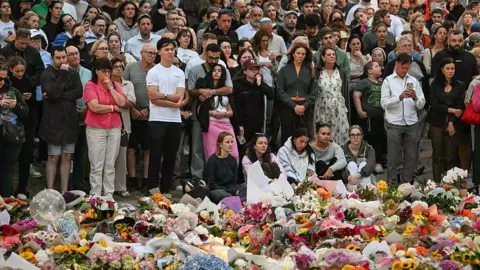 Getty ImagesA flower vigil for the victims of the 14 December Bondi attack
One Nation's resurgence has made others uneasy - particularly people from multicultural backgrounds; more than half of Australia's population were born overseas or have a parent who was.
Labor supporter Gurpreet Bar, 25, is among those concerned. He says he noticed a change in the political climate in South Australia, and more racism during the campaign.
"When political leaders post comments that target Muslims or people of colour, it risks encouraging racism and creating unnecessary division among everyday Australians," Bar told the BBC.
Can populism succeed in Australia?
Will One Nation be able to cement its gains this time?
Previously it has struggled with selecting candidates, keeping members and navigating Australia's unique voting system.
After its breakthrough at the Queensland election in 1998, all 11 of its elected MPs quit the party within two years. One Nation's co-founder David Oldfield was also expelled following a public fracas with Hanson.
Over the years, more than 60% of the party's elected members have left, mostly due to disputes with Hanson or other key leaders, many of whom launched spectacular attacks on the way out.
Former senator Brian Burston accused Hanson of running a "dictatorship" when he quit in 2018.
"There is a real disconnect between the face of party, which is Pauline, and the way the party is run," says Jennifer Game, a former parliamentary speechwriter for Hanson who helped set up the party in South Australia but who also departed One Nation last year.
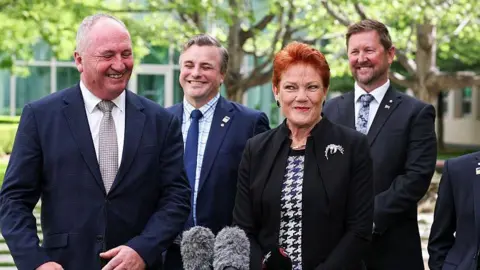 GettyFormer deputy prime minister and Nationals leader Barnaby Joyce (left) recently defected to One Nation
Hanson routinely dismisses these criticisms as evidence of political "elitism" and says former members who criticise the party have a vendetta.
But strong resistance from non-One Nation voters means the party is unlikely to become a dominant party in the near future, pollsters like Samaras say.
He also says Australia's voting system tempers the party's success. It uses a preferential voting system, where candidates are ranked from most to least preferred - which experts say protects the country from extreme swings. Voting is also compulsory.
Associate Professor Dr Jill Shepherd, a political scientist at the Australian National University, agrees that the current voting system would need to change to "break the duopoly" of the major parties.
"One Nation does not have the organisational experience, the discipline, or the resources to seriously contest elections at federal and state elections yet," she adds.
While the conservative vote is currently fragmenting, she predicts that the Coalition will eventually win back disaffected voters, even if not by the next federal election in 2028.
But she says major parties ignore voters' continued drift to minor parties "at their peril".
And Hanson herself isn't deterred. On Saturday night, she said her party was coming for other areas next - like Victoria which is going to an election later this year, and the federal by-election of Farrer in New South Wales in May.
"This is the start of it."