Breaking space news, the latest updates on rocket launches, skywatching events and more!
Contact me with news and offers from other Future brands Receive email from us on behalf of our trusted partners or sponsors By submitting your information you agree to the Terms & Conditions and Privacy Policy and are aged 16 or over.You are now subscribed
Your newsletter sign-up was successful
Want to add more newsletters?
An account already exists for this email address, please log in. Subscribe to our newsletter This image of the moon, showing a sliver of its far side, was captured by NASA's Artemis 2 astronauts during their mission around the moon. (Image credit: NASA)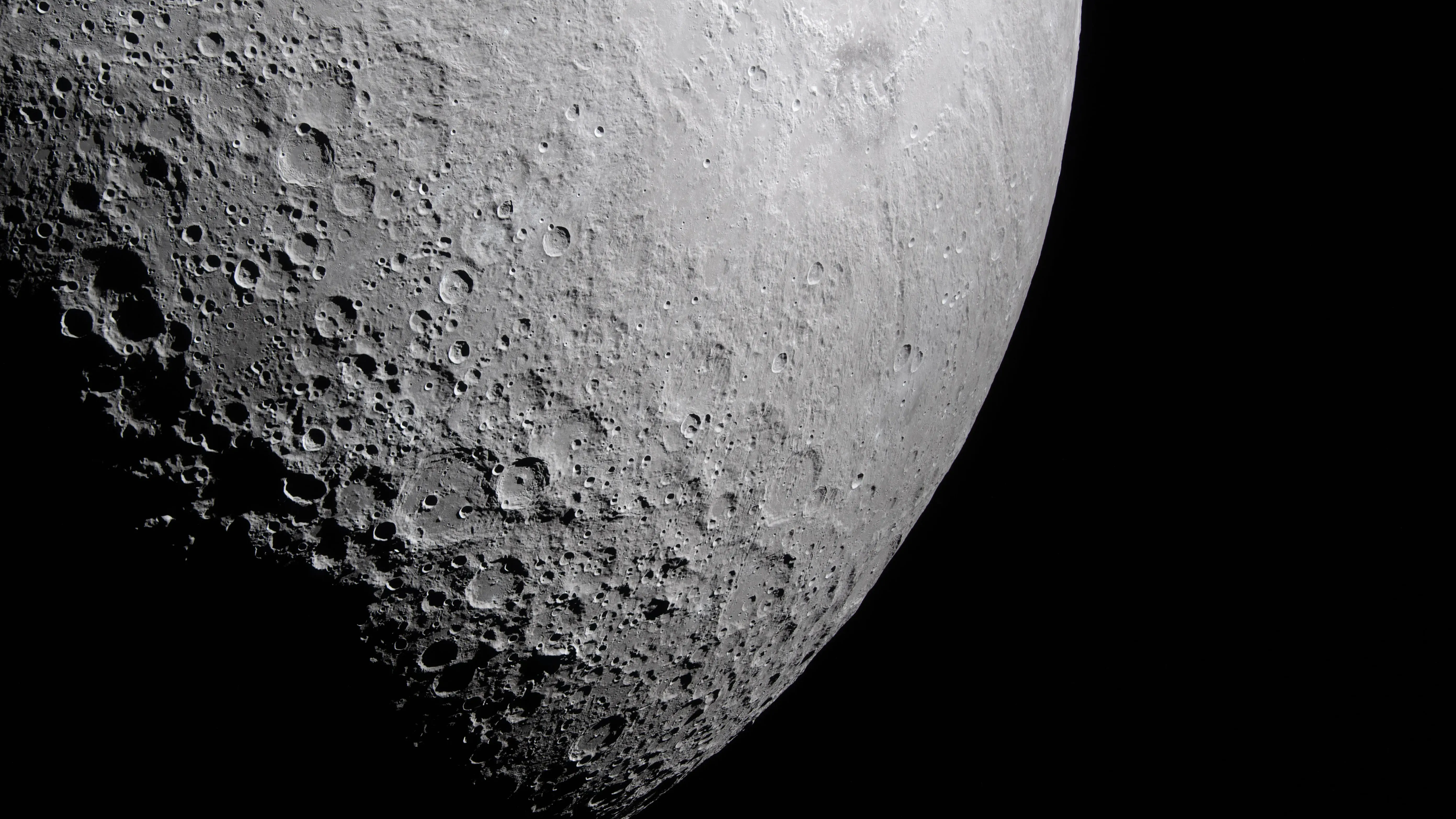
Have you ever seen the far side of the moon?
NOTE: It is not known if the crew was listening to Pink Floyd's "The Dark Side of the Moon" when this image was captured.
Article continues belowWhat is it?
On April 6, the crew onboard NASA's Artemis 2 mission's Orion spacecraft were in the middle of their mission and flying by the moon.
This mission, which launched on April 1 and splashed back down to Earth on April 10, sent a crew of four astronauts on a journey around the moon and back. This was the first crewed mission to the moon since NASA's final Apollo mission in 1972, over 50 years ago.
On their incredible journey, the Artemis 2 crew went farther from Earth than humans have ever gone before — a whopping 252,756 miles (406,771 kilometers) miles from home.
Why is it incredible?
During their lunar flyby, the crew actually flew behind the moon, allowing them to see its mysterious far side.
Get the Space.com NewsletterContact me with news and offers from other Future brandsReceive email from us on behalf of our trusted partners or sponsorsThe moon is tidally locked in our orbit. This means that the moon has a side that is always facing us (the near side) and one that is perpetually facing away (the far side). The far side is sometimes known as the "dark side of the moon," which is inaccurate, because sunlight bathes it as well.
As the Orion capsule flew behind the moon, communications between Earth and the crew actually stopped for about 40 minutes.
This photograph is a beautiful insight into those minutes of quiet, when the crew observed what we so rarely are able to see.
 Chelsea GohdContent Manager
Chelsea Gohd served as a Senior Writer for Space.com from 2018 to 2022 before returning in 2026, covering everything from climate change to planetary science and human spaceflight in both articles and on-camera in videos. With a M.S. in Biology, Chelsea has written and worked for institutions including NASA JPL, the American Museum of Natural History, Scientific American, Discover Magazine Blog, Astronomy Magazine, and Live Science. When not writing, editing or filming something space-y, Gohd is writing music and performing as Foxanne, even launching a song to space in 2021 with Inspiration4. You can follow her online @chelsea.gohd and @foxanne.music
View MoreYou must confirm your public display name before commenting
Please logout and then login again, you will then be prompted to enter your display name.
Logout MORE FROM SPACE... 1'80s sci-fi cult classic 'The Last Starfighter' finally scores a sequel, but it's a comic book! (exclusive)
- 2What's the best time to see Lyrid meteors in 2026?
- 3'Dark subhaloes' may explain why galaxies seem to form pre-determined shapes
- 4Only 12 people on Earth saw this 'ring-of-fire' eclipse. Here's how one improvised to capture a once-in-a-lifetime photo from Antarctica
- 5Watch SpaceX launch advanced GPS satellite for US Space Force early on April 21