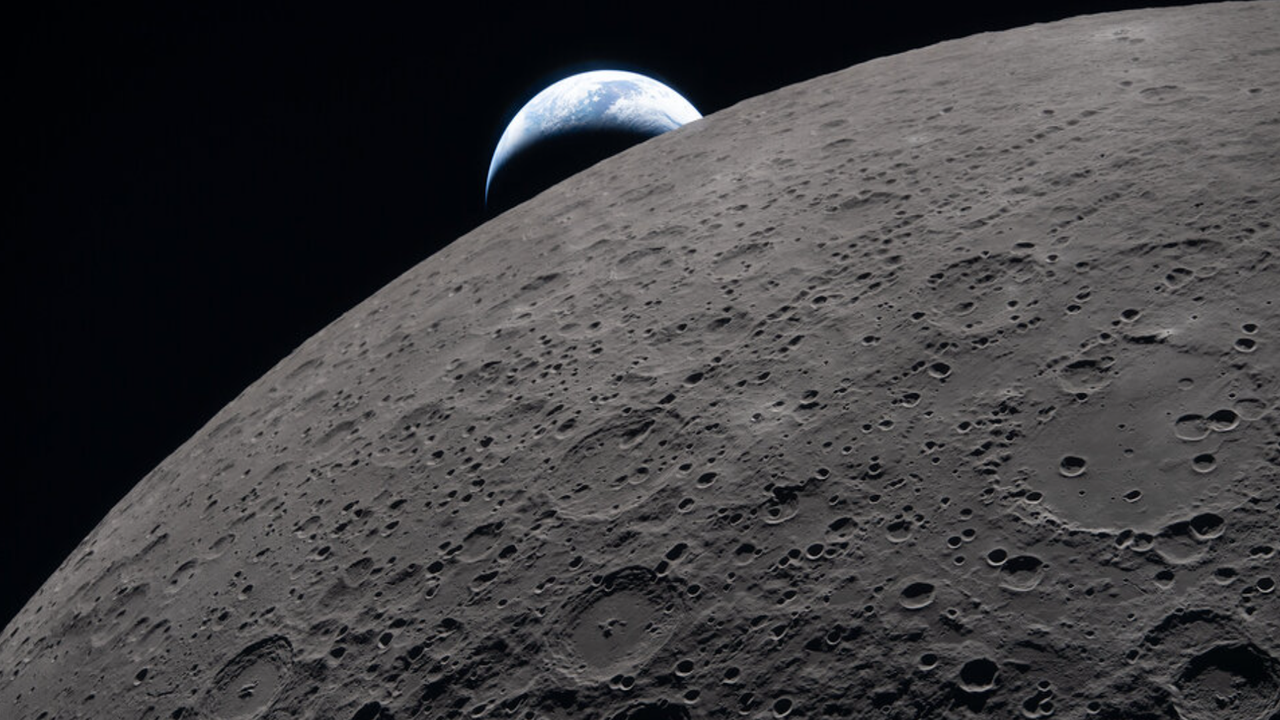
 One of the many amazing photos taken by the Artemis 2 astronauts during their mission around the moon in April 2026. (Image credit: NASA) Share this article 0 Join the conversation Follow us Add us as a preferred source on Google Newsletter Get the Space.com Newsletter
 Breaking space news, the latest updates on rocket launches, skywatching events and more!
Contact me with news and offers from other Future brands Receive email from us on behalf of our trusted partners or sponsors By submitting your information you agree to the Terms & Conditions and Privacy Policy and are aged 16 or over.You are now subscribed
Your newsletter sign-up was successful
Want to add more newsletters?
An account already exists for this email address, please log in. Subscribe to our newsletterI've been imagining what it would be like to go to the Moon ever since 1961 when I was five years old, staring at the artists' conceptions in my childhood space books. When Apollo 8 astronauts Frank Borman, Jim Lovell, and Bill Anders became the first humans to actually go there, during Christmas week of 1968, I was a 12-year-old space fanatic camped out in front of the TV with models of the spacecraft I'd built from kits, maps of the Moon, and articles about the flight — my own personal mission control.
For me, the highlight of the 20 hours Apollo 8 spent in lunar orbit on Christmas Eve came when Borman and his crew made two TV broadcasts with their small onboard black-and-white camera. I was absolutely mesmerized by the images of craters gliding slowly past the spacecraft's windows. I loved their fuzzy, almost dreamlike quality; somehow that fit the momentousness of the event and the almost unimaginable distance between the three Moon voyagers and all of us on their home planet.
As the time for Artemis 2 drew near, my anticipation was mixed with uncertainty. Would this new Moon mission spark the feelings of wonder and excitement I'd had so long ago? Those doubts didn't last long. When astronauts Reid Wiseman, Victor Glover, Christina Koch and Jeremy Hansen headed for the Moon in the Orion spacecraft they named "Integrity," I felt like parts of my brain that had been dormant since 1972 were being reactivated. I listened to every minute of their seven-hour lunar flyby — but this was nothing like the Christmas Eve I'd experienced more than 57 years before. Now NASA's coverage featured extended views from inside the cabin while the astronauts worked, so clear that they could have been aboard the International Space Station 250 miles (400 kilometers) up instead of a thousand times farther away.
As I listened to the astronauts' voices, I felt as if a veil had been lifted: Instead of the restrained, "Right Stuff" delivery of the Apollo 8 crew's transmissions, I heard expressions of exhilaration and even joy. And I was amazed at the richness of detail about the lunar experience that was available to everyone in real time. Even the astronauts' geologic descriptions were filled with human moments that put me in the spacecraft alongside them. As "Integrity" rounded the Moon, Christina Koch likened the appearance of the smallest, freshest lunar craters to "a lampshade with tiny pinprick holes and the light shining through. They're so bright compared to the rest of the Moon." Victor Glover described peering at the long shadows of the lunar terminator through a telephoto lens and suddenly feeling transported down to that airless, forbidding landscape and imagining himself off-road driving among jagged peaks.
For me, the most awesome moment of the entire mission happened when "Integrity" flew into the Moon's shadow, creating a nearly hour-long total eclipse of the Sun — more than 10 times longer than most total eclipses visible from Earth. I was transfixed by video from the spacecraft's external cameras showing the glow of the solar corona slowly disappearing behind the Moon's darkened limb. Aboard "Integrity," the astronauts let their eyes adapt, and soon they could see the Moon's night side set against a dim glow, with a crescent-shaped slice of the cratered globe illuminated in the soft light of Earthshine. I heard Victor Glover say, "We've just gone sci-fi." Suddenly I was filled with curiosity, hungry for more description.
But this was one sight that was beyond their ability to convey in the moment. "It's just, it's indescribable," I heard Reid Wiseman say. "No matter how long we look at this, our brains are not processing this image in front of us. It is absolutely spectacular. Surreal. There's — I know there's no adjectives. I'm gonna need to invent some new ones to describe what we are looking at out this window."
Get the Space.com NewsletterContact me with news and offers from other Future brandsReceive email from us on behalf of our trusted partners or sponsorsThe morning after the flyby, I opened my laptop to find that the astronauts had beamed down their photos of the encounter, and I felt like Rip Van Winkle awakened from a half-century nap. For decades after Apollo, there was no such thing as hi-def scans of the missions' photographic film, but now, just hours after the event, I was looking at full-resolution digital images of stunning beauty, including new portraits of a brilliant blue and white crescent Earth setting and then rising behind the lunar far side's lifeless expanse, taken from the farthest point in deep space that humans have ever reached. I felt a wave of excitement and relief come over me at the realization that a new era of human deep space exploration has finally begun. Now, instead of just looking back, I'm looking ahead.
Andrew Chaikin is the author of "A Man on the Moon: The Voyages of the Apollo Astronauts" (Viking, 1994). His website is www.DoSpaceBetter.com.
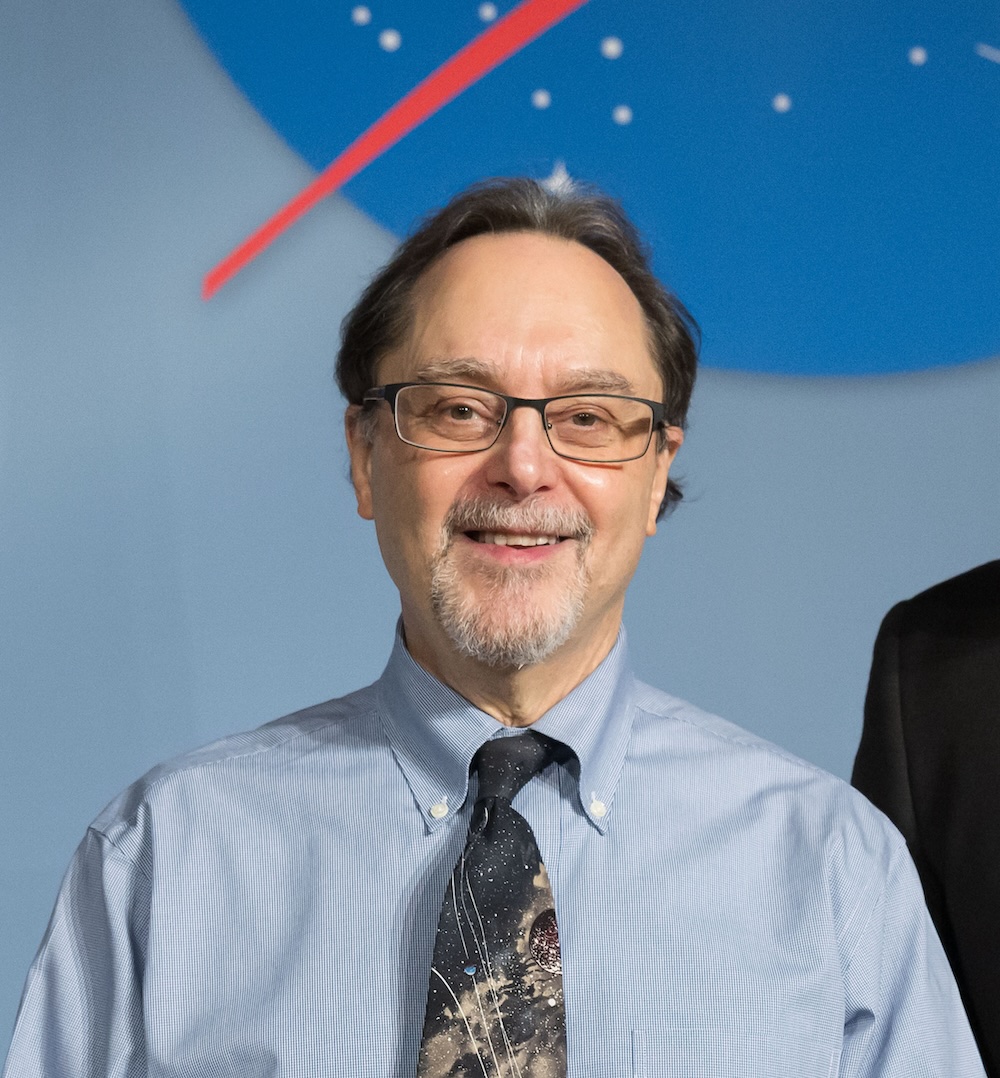 Andrew Chaikin
Andrew Chaikin is an accomplished author, lecturer, science journalist, and space historian who is a former contributing writer for Space.com working in the areas of human spaceflight. This bestselling writer penned the well-known NYT bestselling books "A Man on the Moon," "John Glenn: America's Astronaut," and "A Passion for Mars." A graduate of Brown University, Chaikin first worked as an intern on the Mars Viking missions at NASA’s Jet Propulsion Laboratory,
View MoreYou must confirm your public display name before commenting
Please logout and then login again, you will then be prompted to enter your display name.
Logout MORE FROM SPACE... 1SpaceX fires up next-gen 'Version 3' Starship ahead of landmark May test flight (photos)
- 2How do supergiant exoplanets form? James Webb Space Telescope finds a clue
- 3Space combat was 'critical to mission success' in US war in Iran, Space Force chief says
- 4The 7 best sci-fi movie soundtracks of all time
- 5NASA astronauts joke around with an optical illusion on the ISS | Space photo of the day for April 15, 2026


