An abstract illustration of a light bulb shattering. Physicists are studying what would happen if a single particle of light was sliced apart — unleashing a swarm of unpredictable outcomes. (Image credit: tiero via Getty Images)
Share this article Join the conversation
Follow us Add us as a preferred source on Google Newsletter Subscribe to our newsletter
Physicists recently wondered what would happen if you tried to split a photon — and they found some unexpected behavior that may transform the way we think about particles.
The experiment, in which researchers simulated a photon being sliced by a shutter under various conditions, showed that a severed photon can lead to a complex mixture of zero to infinitely-many photons — raising some big questions about the nature of particle interactions.
Photons are elementary packets of light, which means they are not made up of anything else. So what does it even mean to try splitting a photon? It may be possible thanks to wave-particle duality — a core principle of quantum mechanics, the bizarre physics of the very small.
According to wave-particle duality, a photon is not only a particle but also a wave. Using theoretical calculations, the researchers investigated what would happen if you sent this photon through a shutter and closed it while the photon was passing through, effectively cutting off the tail end of the photon wave.
"I think that most physicists would expect there to be a certain probability that you have zero photons and a certain probability that you have a single photon left after you have done this," Johannes Skaar, co-author of the new study and a professor of theoretical physics at the University of Oslo, told Live Science. "And that is approximately true, but it is not exactly true."
What are the chances?
This brings up another strange aspect of quantum mechanics: its probabilistic nature. Particles exist as a cloud of probabilities stretching to infinity. Until a particle is observed, its properties, such as its position or energy, are in a superposition of possible values; all we can know are the chances of finding it in a certain state.
Through their calculations, Skaar and his colleagues determined how cutting a photon affects these probabilities. In their study, recently accepted in the journal Physical Review Letters, they found that it would create a complex mixture of photon states, including one with an infinite number of photons.
Sign up for the Live Science daily newsletter now
Get the world’s most fascinating discoveries delivered straight to your inbox.
Contact me with news and offers from other Future brandsReceive email from us on behalf of our trusted partners or sponsors
Each of these states has a probability that depends on how quickly the shutter cuts the photon. The expected number of photons becomes infinite only if the shutter is closed infinitely quickly. For realistic shutter speeds, even a thousand photons would be extremely unlikely.
This may sound very strange, but the quantum physicists were unfazed. In fact, what surprised Skaar and his colleagues was what happens if you make measurements of the cut photon from different perspectives.
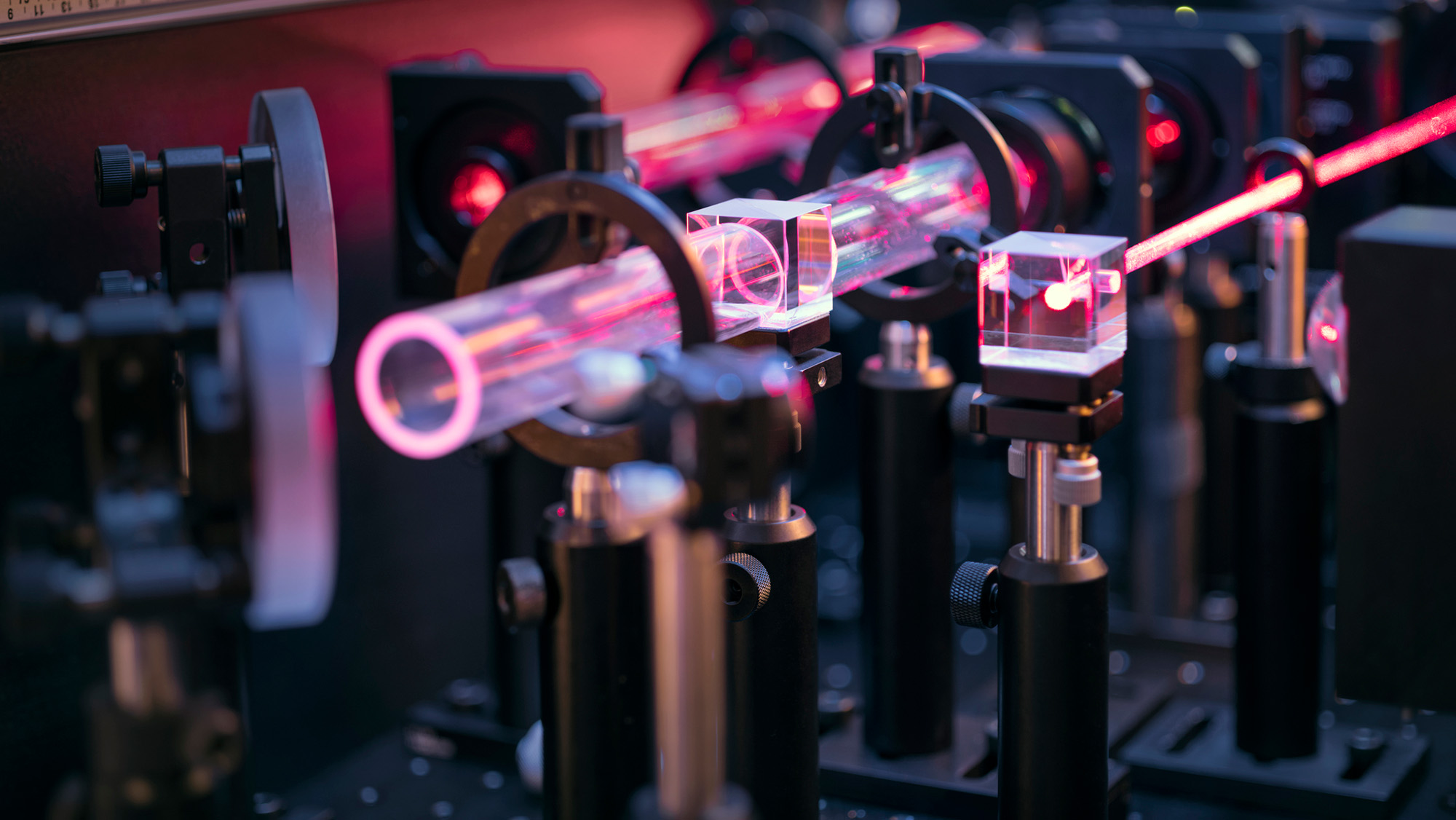
A photo of an optical table with laser and beam-splitting cube, often used in photonics research.
(Image credit: EschCollection via Getty Images)
"When you measure from one side of the shutter, then it will look like a single photon state," Skaar said. "Then, on the other side, it will look like a vacuum state — that means no photons. And that is very strange because the actual state globally is this mixture from zero to infinity."
Changing how we think about particles
The fact that these complex mixtures can be treated locally as very simple states raises fundamental questions about the nature of particles. Skaar said they are still reckoning with the full extent of these implications and they are now considering how this process could play out for other quantum particles, such as electrons.
Related stories
Physicists confirm 'negative time' is real by asking the atoms themselves
The shape of light: Scientists reveal image of an individual photon for 1st time ever
Quantum physicists discover 'negative time' in strange experiment
They hope that by following this theoretical thread through, they may be able to develop a neater way of describing particle interactions. Currently, particles' infinite stretching means they have been interacting for an infinite amount of time. This then poses a problem for causality — the order of cause and effect — in particle interactions, the team said.
These new theoretical photons with a cutoff tail would not have this problem, meaning the causal link in an interaction would be clear, Skaar said. He admitted that there is much more work to be done to develop the theoretical description of this interaction. However, the new result is an important step toward describing particle interactions with a clear causal relationship, which Skaar described as the team's "ultimate goal."
Article Sources
Cecil Onsager Rukan, I., Gulla, J., & Skaar, J. (2026). Truncated photon. Physical Review Letters. https://doi.org/10.1103/94pm-hp34
 Rory Harris
Contributor
Rory Harris is a science writer, covering a wide range of topics but with a specialty in astronomy and particle physics. He holds a Master's degree in Physics from the University of Manchester and an MSc in Science Communication from Imperial College London.
View More
You must confirm your public display name before commenting
Please logout and then login again, you will then be prompted to enter your display name.
Logout