

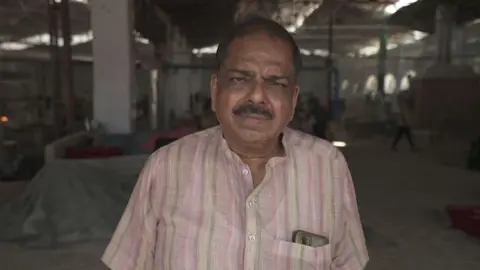
 Pritam Roy/BBCSanjay Jain says production at his glass bangle factory has dropped in the past few weeks
Tensions in the Middle East are rippling far beyond the region - and are now being felt in India's "glass city" Firozabad, where thousands of jobs are at risk.
In this city in northern Uttar Pradesh state, about 50km (30 miles) from the famed Taj Mahal, glass is at the centre of life. Firozabad produces 70% of the country's glass, much of it in small and medium-sized factories.
The industry employs some 150,000 people who earn between 500 rupees ($5.29; £3.91) and 1,000 rupees a day - incomes that leave little margin for rising prices.
Now, those factories are under strain - and the biggest reason is gas.
Glassmaking depends on a steady supply of natural gas to keep furnaces running at extremely high temperatures. But as tensions disrupt energy flows from the Middle East, supplies have become uncertain and costs have risen.
Much of the disruption is linked to the Strait of Hormuz - a narrow shipping route in the Gulf through which nearly half of India's gas imports pass. While some shipments have resumed in recent weeks, factory owners say the benefits are yet to reach them.
Sanjay Jain, who has run a glass bangle unit in Firozabad for four decades, said production has dropped sharply after the Indian government cut commercial gas supplies by 20% in a bid to tide over the supply squeeze.
"These furnaces have to keep running - if they cool, they can be damaged," he said, adding that restarting them is "time-consuming and expensive".
To cope, he keeps the furnaces on but at lower temperatures and halts production for three to four days at a time to ration gas.
Jain's situation reflects a wider vulnerability. India's heavy dependence on gas - across industry, transport and households - leaves factory towns like Firozabad particularly exposed to supply shocks.
More than 400 small manufacturing clusters here make glass items ranging from car headlamp covers and bangles to light shades, decorative items and chandeliers, feeding a domestic market worth over $200mn.
Some owners report losses of 25-40% since the war began, and say they are uncertain how long they can continue if supplies remain unstable.
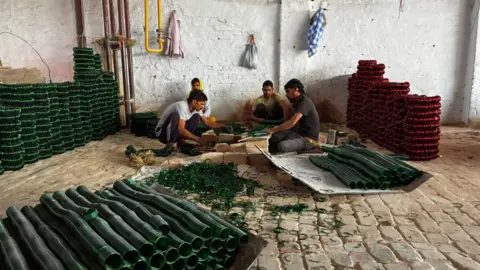 Neyaz Farooquee/BBCMore than 150,000 people work in Firozabad's glass factories
 But gas shortages are only part of the problem.
Industry experts say a mix of other pressures is also making things harder.
The chemical components used to melt glass are sourced from across India, with some imported from the Middle East, says Mukesh Bansal of the All India Glass Manufacturers' Federation.
"With fuel supplies disrupted and imports affected, the cost of raw materials has gone up," he said, adding that his business has seen losses of more than 45% since the conflict began.
"This, combined with the gas shortage, is making matters worse."
Exports have also been hit. Bansal says higher shipping costs have made it more expensive to send decorative glass items abroad, particularly to the US.
Last week, the federal government said it "recognises the need for uninterrupted furnace operations" and is taking steps to manage supplies.
But experts say that for many smaller units, the situation is not sustainable.
"Since the labour-intensive sectors are small and micro units with only a little working capital, they are not able to cope with the shortages," said economist Arun Kumar.
"If this goes on, these units are at risk of shutting down, or working at curtailed levels," he added.
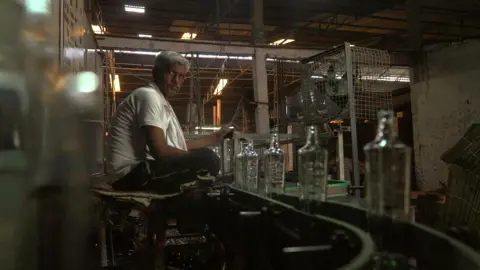 Workers are now worried they'll lose their jobs if gas supplies don't get back to normal
The situation reflects the fragility of the industry - and how quickly disruptions can ripple through the livelihoods it supports.
Glass production is a key part of India's small and medium-sized sector, which accounts for about 30% of gross domestic product and employs hundreds of millions of people. Disruptions to industries like this can, therefore, have a direct impact on incomes, particularly for low-wage workers.
That pressure is already being felt in everyday life.
The conflict in the Middle East has hit workers who were already grappling with rising living costs. Wages for many families have failed to keep pace with inflation, while recent increases in cooking gas prices - linked to global supply disruptions - have added to the strain.
- Indian firms feel the squeeze as Iran war disrupts gas supplies
- Gas shortage caused by Iran war may push India back to dirtier fuels
- Fears cost of water and beer to soar as India's scorching summer hits
A recent UN Development Programme report warns that the conflict could push as many as 2.5 million people in India into poverty.
Frustration spilled over earlier this month, when thousands of factory workers in parts of northern India blocked roads demanding higher wages and better working conditions. What began as largely peaceful protests escalated in some areas, turning violent in parts of Uttar Pradesh. The state later announced a temporary wage increase, but workers said it fell short of their demands.
The government says it is stepping in to manage the fallout.
Federal ministries have been holding regular briefings and say they are taking steps to ensure stable supplies of petroleum products and cooking gas. The petroleum ministry says it has prioritised energy supplies to key sectors such as pharmaceuticals, steel, automobiles and agriculture.
But economist Kumar says longer-term measures will be needed to manage the crisis.
During the fighting in March and early April, energy infrastructure across parts of the Middle East was targeted - damage that could take months to repair and delay a return to stable supplies.
"For months after the Strait reopens, the situation will not return to normal," he said.
For workers in Firozabad, that uncertainty is already part of life.
Umesh Babu, 35, spends long hours in sweltering conditions making bangles in an open-air workshop under a tin roof that offers little relief from the heat.
The furnace, burning at more than 1,000C, is something he has learned to live with.
What worries him is how he will provide for his family if the work dries up.
"Earlier we would get at least six days of work a week, now it's down to four," he said. To cut costs, Babu says he has withdrawn his children from school.
"If the factories stop hiring us, I don't know what else to do. This is the only skill I have."
Follow BBC News India on Instagram, YouTube, X and Facebook.
Middle EastAsiaIranIndiaIran war