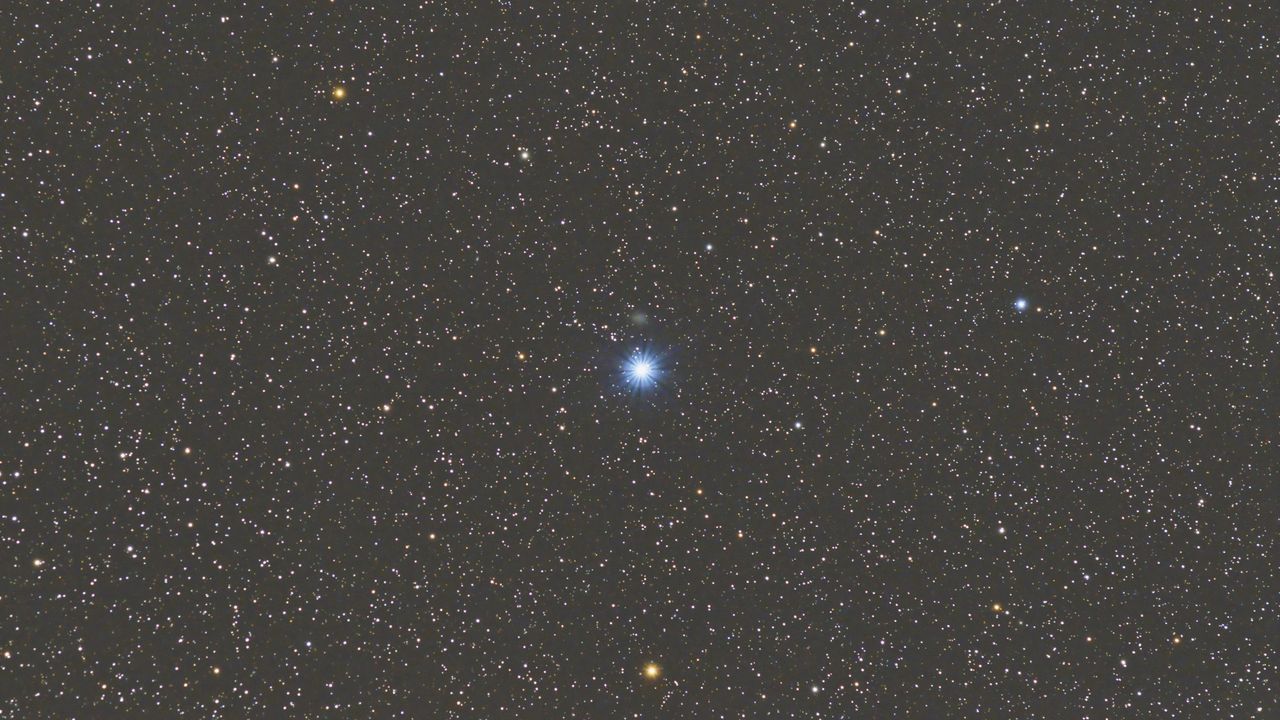
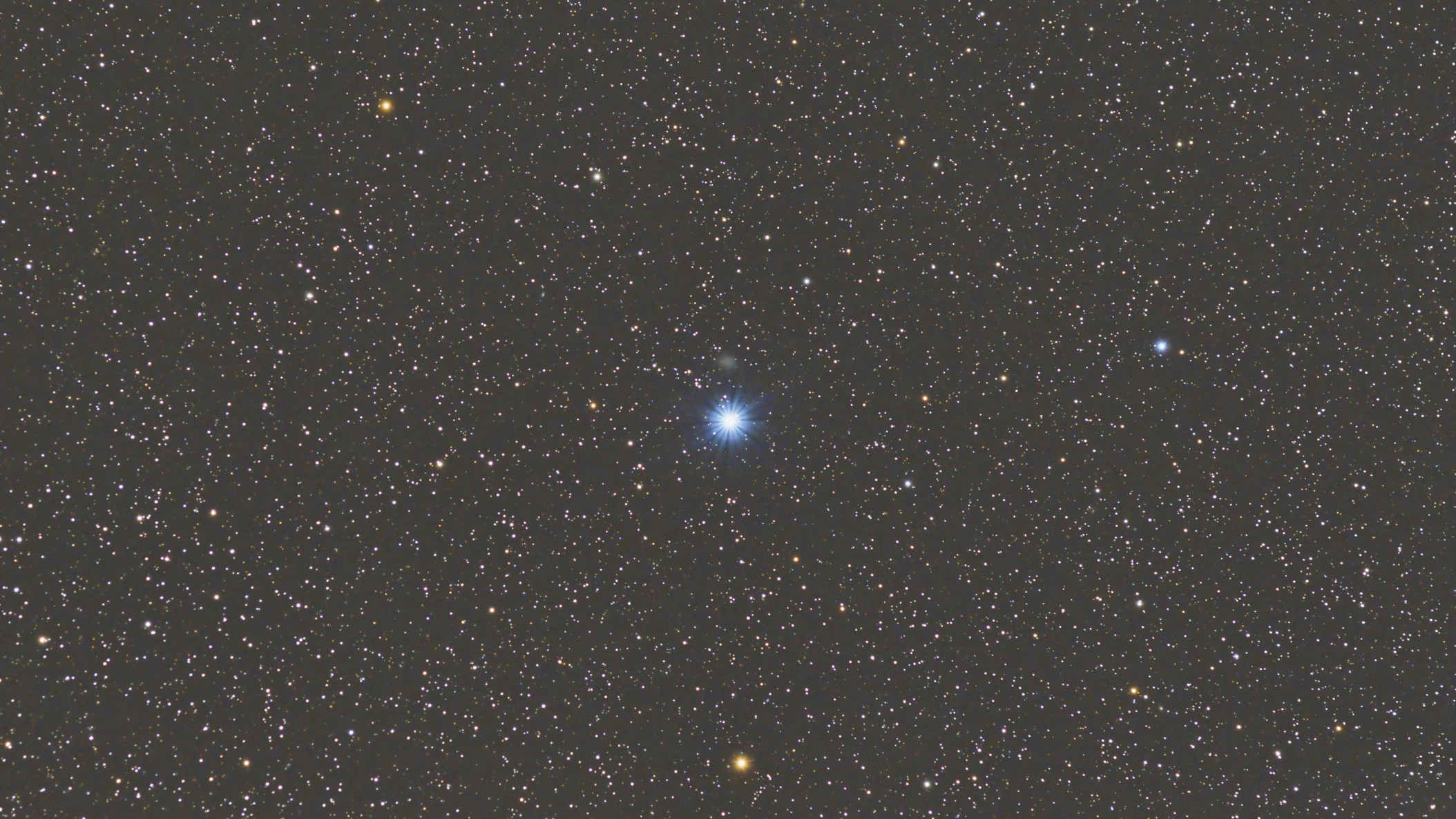
 Regulus, in the constellation Leo. (Image credit: Franco Tognarini via Getty Images) Share this article 0 Join the conversation Follow us Add us as a preferred source on Google Newsletter Get the Space.com Newsletter
 Breaking space news, the latest updates on rocket launches, skywatching events and more!
Contact me with news and offers from other Future brands Receive email from us on behalf of our trusted partners or sponsors By submitting your information you agree to the Terms & Conditions and Privacy Policy and are aged 16 or over.You are now subscribed
Your newsletter sign-up was successful
Want to add more newsletters?
An account already exists for this email address, please log in. Subscribe to our newsletterIf you live in the middle Atlantic or southeast part of the United States, you'll have an opportunity on Saturday evening, April 25, to see a 70% illuminated waxing gibbous moon gradually drift toward and ultimately hide the 1st-magnitude star, Regulus, the brightest star of the constellation Leo the Lion.
This event is called an occultation, a word that is derived from the Latin occultāre, which means literally "to conceal." And if you are fortunate enough to live in the zone of visibility for this event (see below), that's exactly what you will see on Saturday evening: the moon, appearing to temporarily conceal Regulus from your view.
The star will reappear from behind the moon's sunlit edge sometime later. To see the reappearance, you'll most definitely need a telescope, since the star will be buried in the glare of the moon's brilliant limb — a tiny blue-white diamond suddenly and dramatically erupting into view on the lunar horizon.
Zone of visibility
If you live anywhere to the south of a line that curves roughly from near De Tour Village, Michigan, across Lake Huron to Mississauga, Ontario, then on southeast across a portion of western New York, northeast Pennsylvania and continuing through western and central New Jersey, you'll see the moon passing in front of Regulus. If you live north of this line, you'll see the moon slowly glide below Regulus, resulting in a tantalizing near miss!
From New York City, Regulus will appear closest to the moon's dark upper limb at 9:04 p.m. EDT, missing it by just a scant 30 arc seconds or a mere 1/63 of a lunar diameter! From Boston, the closest approach comes at the same time as New York, but the gap between the two will be somewhat wider, equivalent to 2.9 arc minutes or about 0.05 degrees.
Still exceptionally close.
Get the Space.com NewsletterContact me with news and offers from other Future brandsReceive email from us on behalf of our trusted partners or sponsorsAnd if your town or city happens to lie fortuitously within about two or three miles on either side of the line, you may have an unusual opportunity to see the grazing occultation of a 1st-magnitude star. As Regulus appears to move tangent to the moon, it might just disappear and reappear a few times along the rugged terrain of the moon's dark limb, just off to the left of its upper cusp. The best place to witness this is New Jersey, where twilight will be rapidly fading and the background sky will be quite dark.
Observers along New Jersey's narrow graze line will see Regulus blink on and off as the moon's rugged limb passes in front of it. (Image credit: Joe Rao (background added in Canva Pro))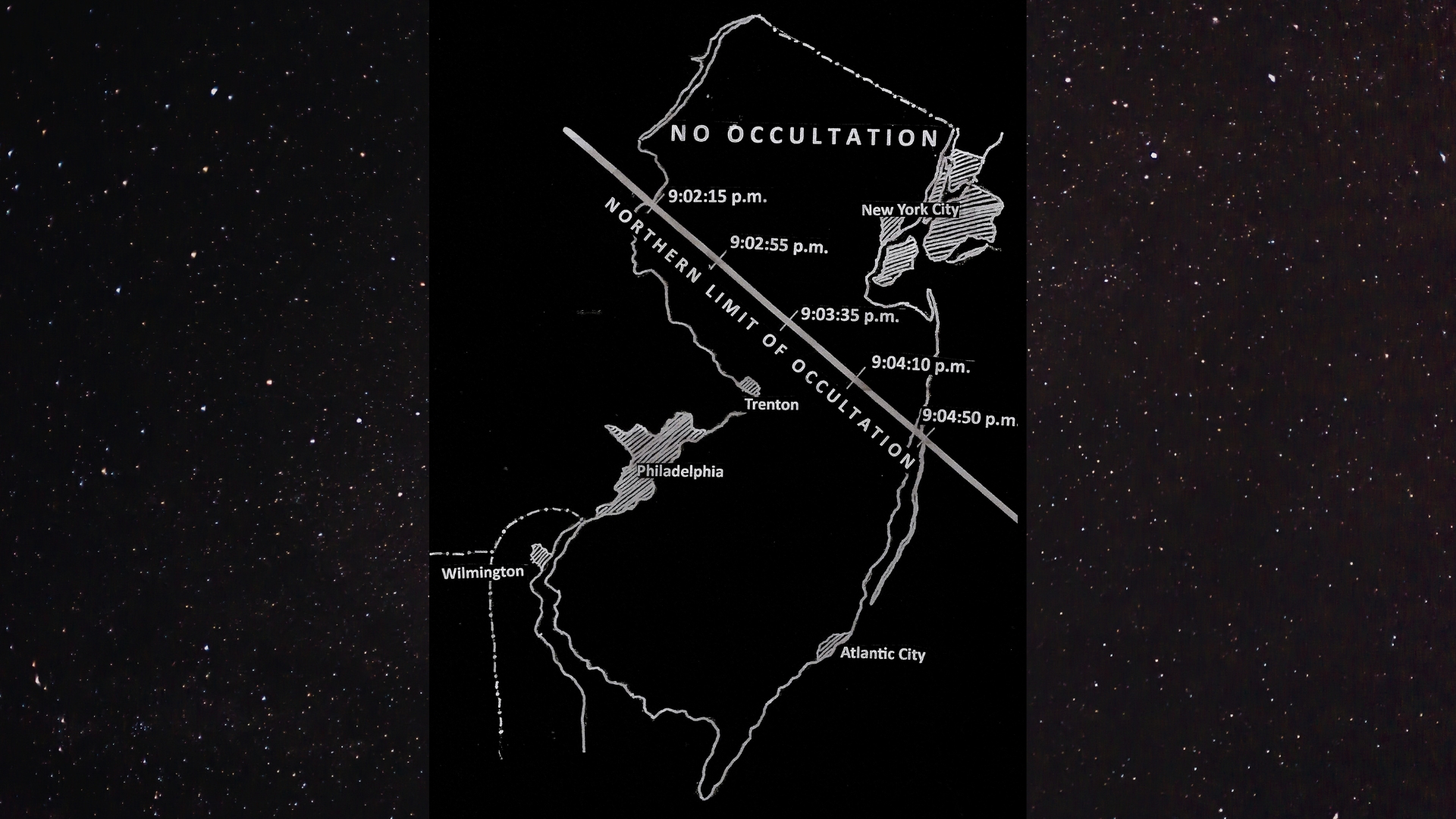
Dark or bright sky?
Another important consideration is whether the occultation occurs against a dark sky, a twilight sky, or a daytime sky.
The optimal locations for viewing this event will be central and southern New Jersey, as well as near and along the Pennsylvania/New Jersey border. Also, right along and near the immediate shoreline of the Delmarva Peninsula, down to about Ocean City, Maryland. Lastly, the Outer Banks of North Carolina. From all these locations, Regulus will disappear behind the moon's dark limb against a cobalt-blue sky during nautical or late twilight, with the sun at least 12 degrees below the horizon.
Going about 100 miles to the west places you under mid-twilight conditions; the background sky is a bit brighter, but you still should be able to see Regulus using binoculars. Going farther west, however, brightens the sky even more and anywhere west of a line from approximately central Michigan, going south through east-central Kentucky to the Gulf Coast will be bathed in full daylight. If you are using a telescope, you should still be able to get a glimpse of Regulus against the blue daytime sky, so long as your sky is clear and free of any haze and the sun is low to the horizon. Of course, it also helps when you know in advance that the star is situated right next to the moon.
For all the above-mentioned locations, the reappearance of Regulus will occur either in a completely dark sky or during deep (late) twilight.
Regulus' path behind the moon from six cities. Near the northern limit, the star grazes the moon's upper edge. (Image credit: Graphic by Joe Rao, who plotted the various paths onto a view of the moon from NASA's Scientific Visualization Studio. Background added in Canva Pro.)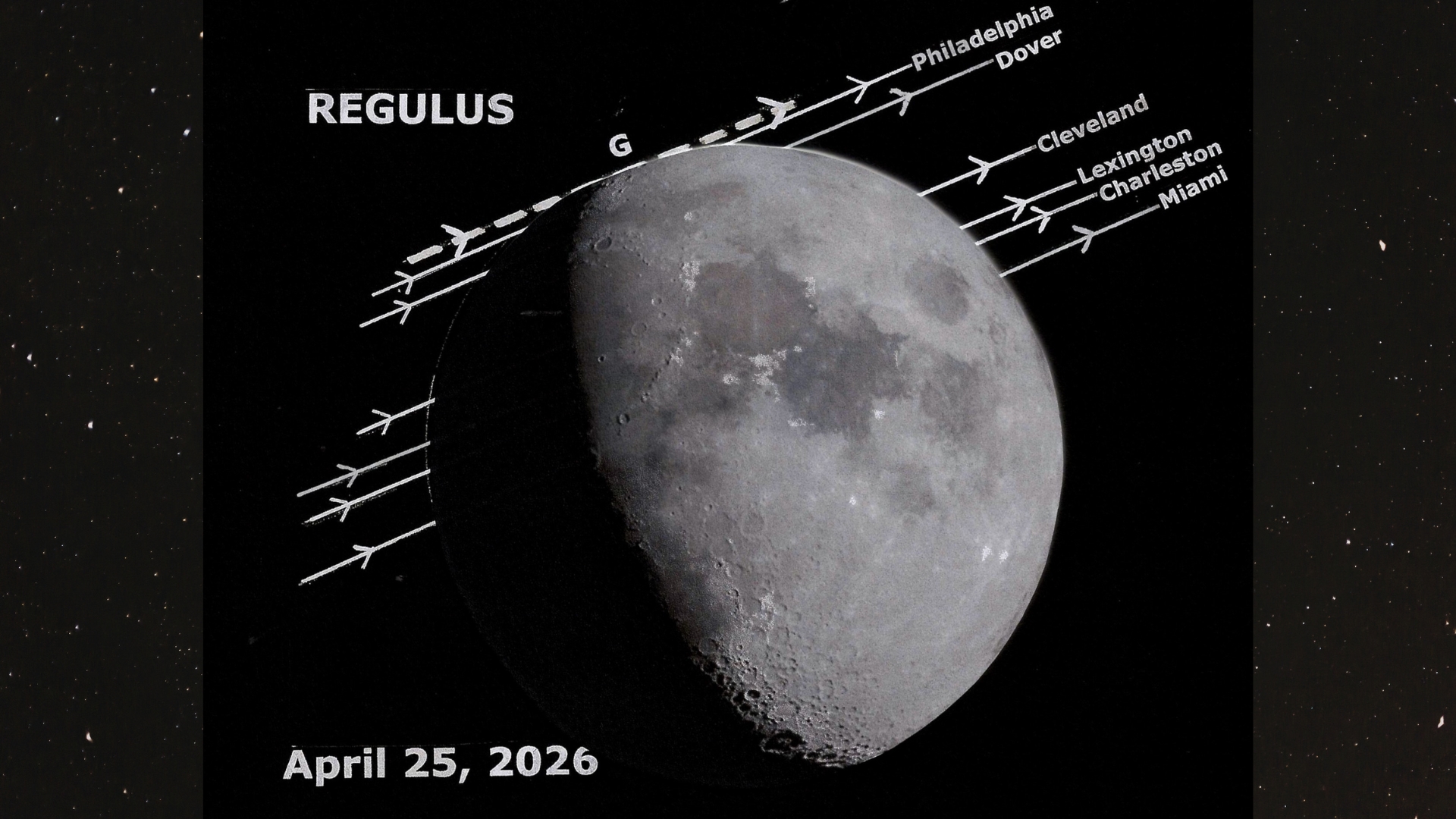
Full schedule
We have provided a graphic showing Regulus's track behind the moon on the evening of April 25, as viewed from selected locations in the eastern United States.
The table below provides the times of Regulus's disappearance and reappearance at 15 selected locations. All are in the Eastern time zone. Those times listed with an asterisk (*) indicate that the disappearance occurs either during bright evening twilight or at sunset. All other times occur during the period from mid-twilight through the end of evening twilight.
Swipe to scroll horizontallyoccultation of Regulus on April 25, 2026Location
Disappearance (ET)
Reappearance (ET)
Lexington, KY
8:18 p.m.*
9:24 p.m.
Atlanta, GA
8:18 p.m.*
9:35 p.m.
Detroit, MI
8:28 p.m.*
9:10 p.m.
Charleston, WV
8:29 p.m.*
9:42 p.m.
Cleveland, OH
8:30 p.m.*
9:14 p.m.
Cape Canaveral, FL
8:30 p.m.
9:52 p.m.
Miami, FL
8:33 p.m.
9:59 p.m.
Norfolk, VA
8:41 p.m.
9:03 p.m.
Niagara Falls, NY
8:42 p.m.*
9:02 p.m.
Salisbury, MD
8:46 p.m.
9:24 p.m.
Dover, DE
8:48 p.m.
9:20 p.m.
Williamsport, PA
8:49 p.m.
9:09 p.m.
Philadelphia, PA
8:52 p.m.
9:15 p.m.
Atlantic City, NJ
8:54 p.m.
9:16 p.m.
Allentown, PA
8:55 p.m.
9:09 p.m.
A detailed set of predictions for 660 selected locations is available on the website of the International Occultation Timing Association (IOTA). Times are given in Universal Time (UT) and included is a color-coded map depicting the region of visibility.
Joe Rao serves as an instructor and guest lecturer at New York's Hayden Planetarium. He writes about astronomy for Natural History magazine, Sky and Telescope, The Old Farmer's Almanac and other publications.
 Joe RaoSkywatching Columnist
Joe Rao is Space.com's skywatching columnist, as well as a veteran meteorologist and eclipse chaser who also serves as an instructor and guest lecturer at New York's Hayden Planetarium. He writes about astronomy for Natural History magazine, Sky & Telescope and other publications. Joe is an 8-time Emmy-nominated meteorologist who served the Putnam Valley region of New York for over 21 years. You can find him on Twitter and YouTube tracking lunar and solar eclipses, meteor showers and more. To find out Joe's latest project, visit him on Twitter.
View MoreYou must confirm your public display name before commenting
Please logout and then login again, you will then be prompted to enter your display name.
Logout MORE FROM SPACE...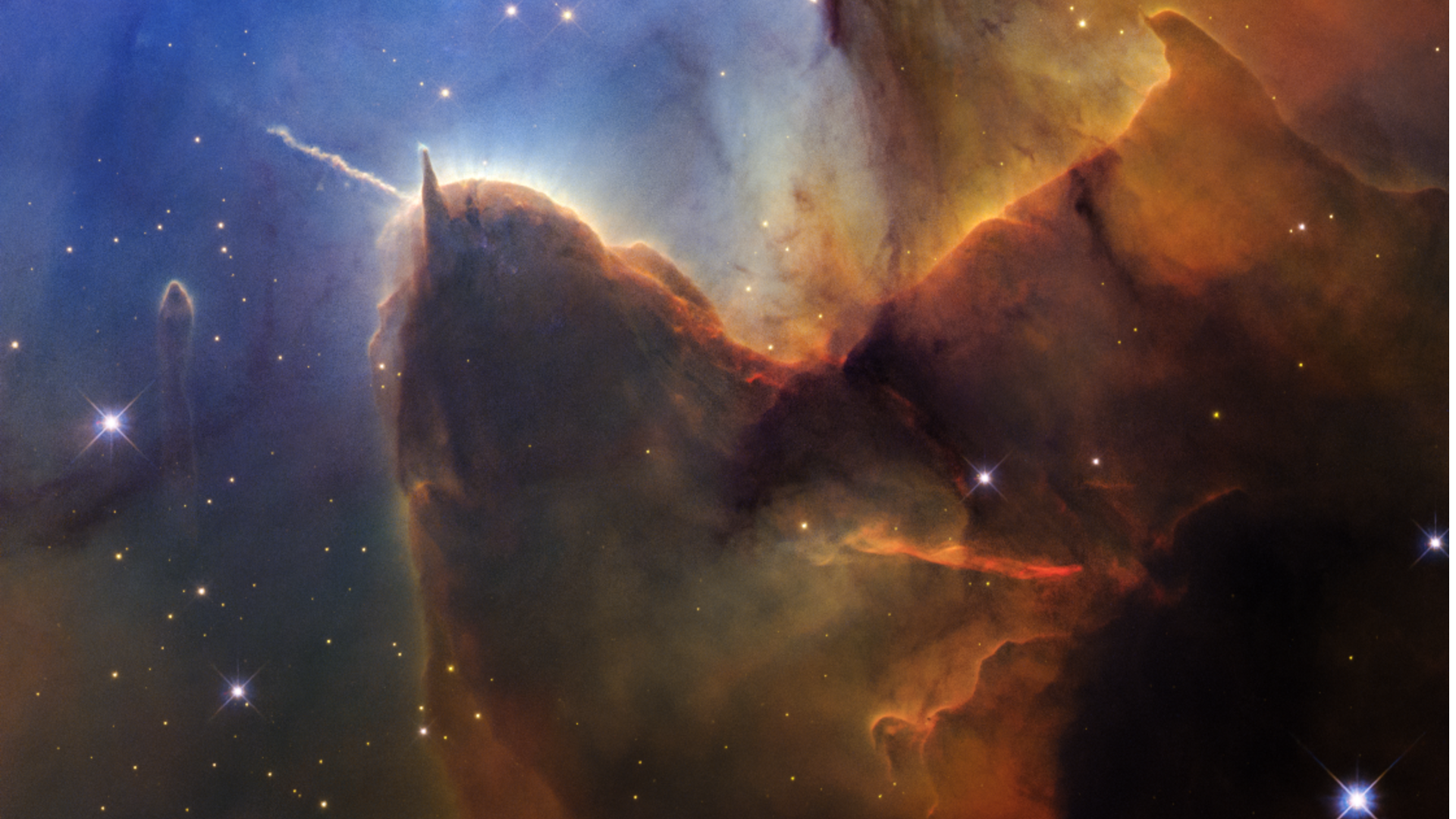 1Hubble Telescope celebrates 36th anniversary with gorgeous new image of famous Trifid Nebula
- 2Sun unleashes 2 colossal X-flares within 7 hours of each other, knocking out radio signals on Earth
- 3Ted Cruz pushes back on NASA budget cuts: 'I don't want to wake up one day and look up at the moon and realize the Chinese have beat us there'
- 4Could 'The Mandalorian and Grogu' restore the 'Star Wars' spark? Watch the electrifying final trailer and decide if this is the way
- 5What will happen when our sun starts dying? These 'stellar archaeologists' may have found a clue