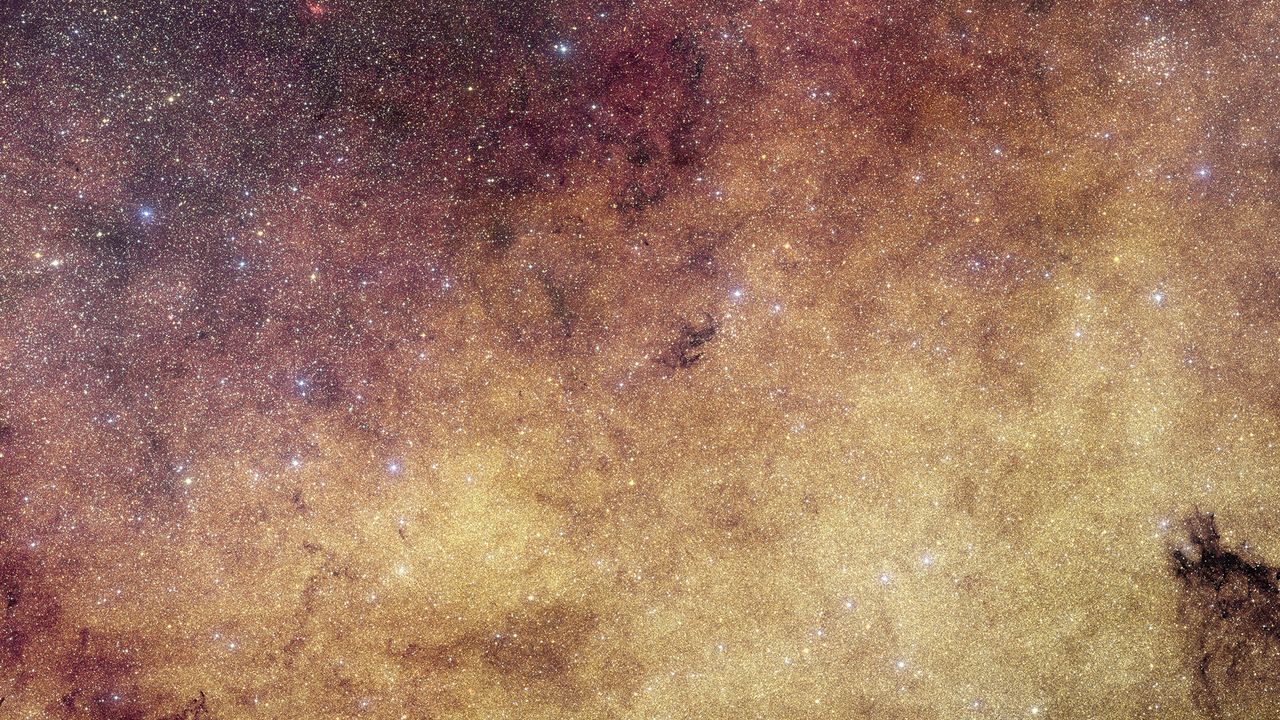
A deep-space telescope on a grand mission to make the largest-ever 3D map of the universe just peered into the star-filled heart of the Milky Way. In the new observations, shared Wednesday (June 24), the Euclid space telescope imaged the center of the Milky Way in extraordinary detail, showing off more than 60 million stars crowded in the galaxy's center.
The shiny new image from the European Space Agency (ESA) spacecraft will help astronomers confirm newfound exoplanets and use changes in starlight to measure those planets' masses as they orbit their parent stars, according to ESA scientists.
The image was taken in 26 cumulative hours in March 2025, across nine pointings of the telescope's visible-light camera toward the galaxy's center, also called the galactic bulge. Each viewpoint captured a slice of sky larger than the full moon. In a statement, ESA praised the performance of Euclid under challenging conditions.
"Designed to observe billions of faraway galaxies, the space telescope's visible-light camera is sensitive enough to tell apart individual stars in our super-crowded galactic bulge, without being blinded," agency officials wrote.
The mosaic image will help NASA's Nancy Grace Roman Telescope with its upcoming planet-hunting mission, after that observatory launches aboard a SpaceX Falcon Heavy rocket from NASA's Kennedy Space Center in Florida no earlier than Aug. 30.
One way the Roman telescope will search for new worlds is through microlensing, the same technique that can be used to examine exoplanets in the new Euclid image. Microlensing happens when one star passes in front of another from the perspective of an observer. The gravity of the closer-up star briefly bends and magnifies the light of the star behind it, allowing possibly unseen planets to pop up near that star.
An image of the Milky Way as seen from Earth, showing two zooms of Euclid's target area. (Image credit: ESA/Euclid/Euclid Consortium/NASA, CFHT, ESA/Gaia/DPAC,image processing by J.-C. Cuillandre and E. Bertin (CEA Paris-Saclay))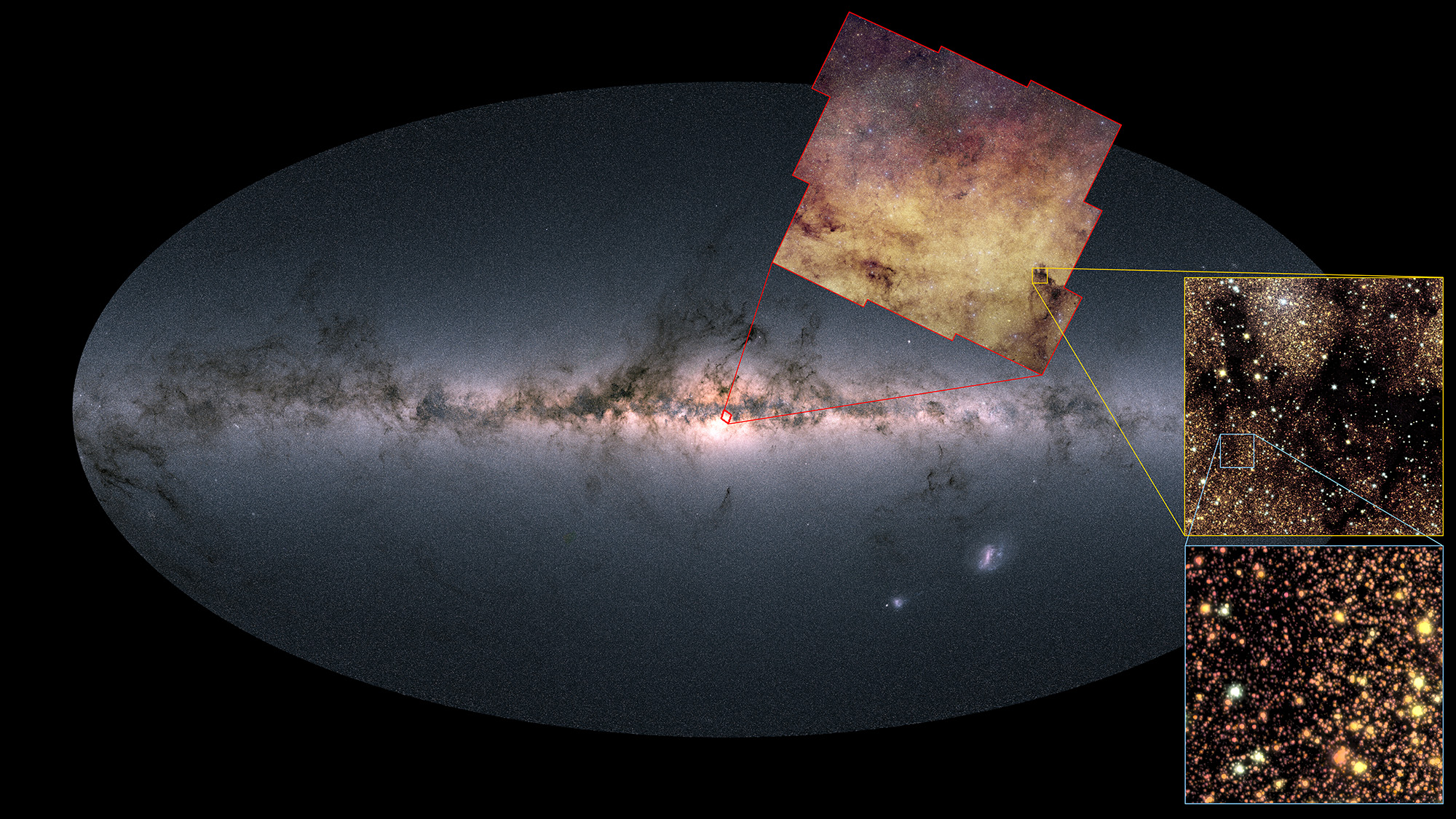
"During the last 20 years, almost 300 exoplanets have been discovered using this technique, all with ground-based telescopes and all towards the centre of our galaxy," Jean-Philippe Beaulieu, who initiated the Euclid galactic bulge survey and co-led the Euclid Consortium's exoplanet working group, said in the ESA statement.
"This image from Euclid includes 51 known planetary systems — and it will assist in studying many more that will be found," added Beaulieu, who holds positions at the Paris Institute of Astrophysics and the University of Tasmania in Australia.
An infographic showing how Euclid sees across the Milky Way, into the galaxy's central bulge. The bottom panels illustrate the diversity of structures in Euclid's field of view. (Image credit: ESA/Euclid/Euclid Consortium/NASA, CFHT, image processing by J.-C. Cuillandre and E. Bertin (CEA Paris-Saclay); Milky Way artist impressions: ESA/Gaia/DPAC, Stefan Payne-Wardenaar))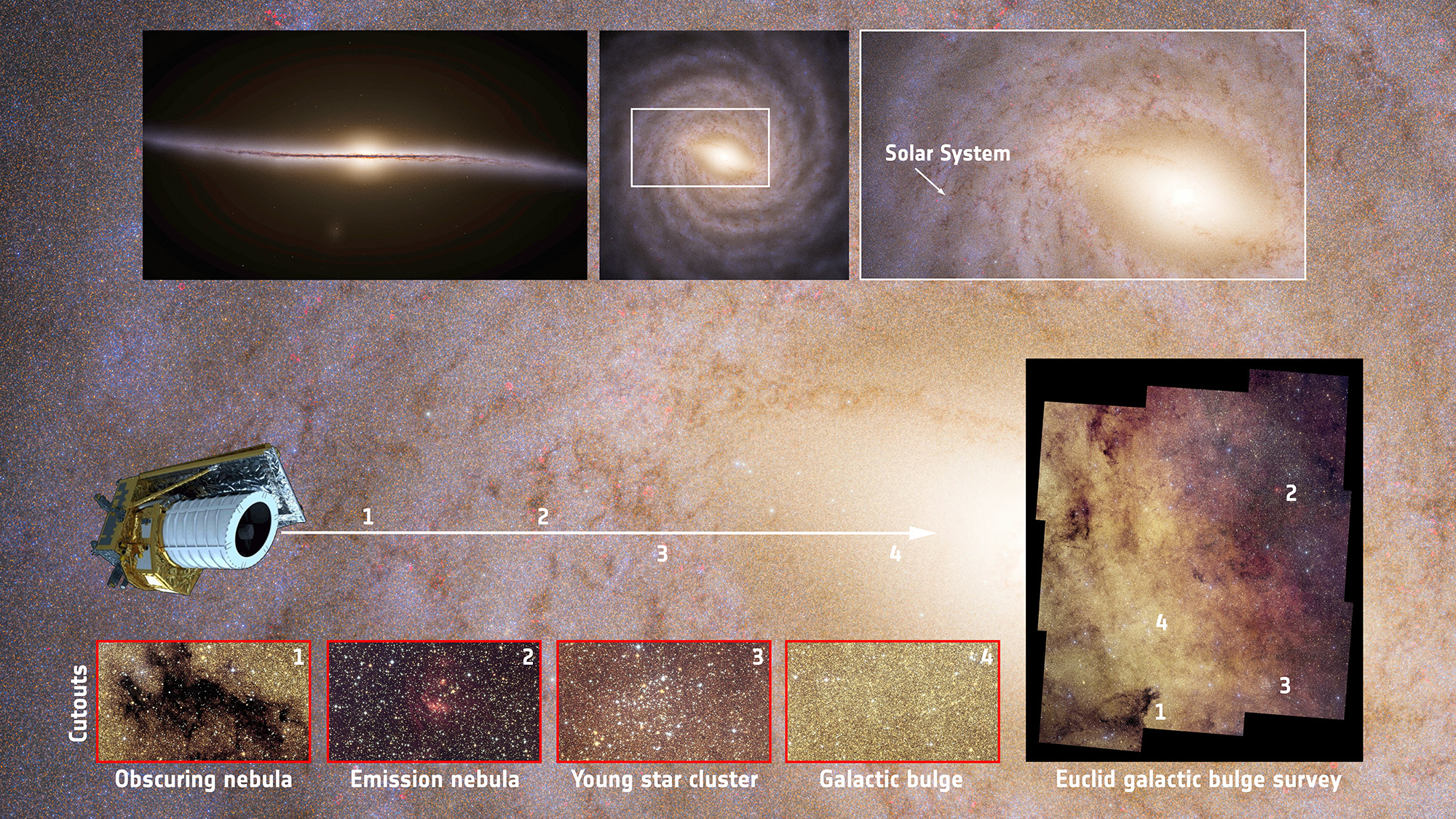
A cosmic time capsule
Euclid's observing window was too short to find a microlensing event, which requires more than 20 days of examining one star to watch for a planet's orbit and associated changes in the star's light. But Euclid's work did allow astronomers to measure already-known planets. And once newer planets are confirmed by other telescopes, the image will let astronomers look back to confirm those newfound worlds' masses.
Related stories- Euclid telescope spots rare 'Einstein ring' hiding near Earth — and an ancient, unnamed galaxy behind it
- Euclid telescope reveals 1st section of largest-ever 3D map of the universe — and there's still 99% to go
- Hubble and Euclid capture the final act of a dying star — and it's glorious
"In 24 hours, Euclid has already captured the stars involved in all the future microlensing events that the Roman space telescope will detect, but before the stars and planets involved have aligned," Natalia Rektsini, a postdoctoral fellow at the Paris Institute of Astrophysics who led the release of Euclid's galactic bulge survey data, explained in the statement.
"Anyone who detects a microlensing event in the same region, for example with Roman, will be able from now on to use Euclid data as a time reference in the past and see how the stars looked before they overlapped," she added. "Since Euclid can clearly separate individual stars, one can then measure how fast they move over time, and use that information to confirm the existence of a planet and determine its mass. This would not be possible with data from one point in time."
How well do you know our home galaxy? Find out with our Milky Way quiz!