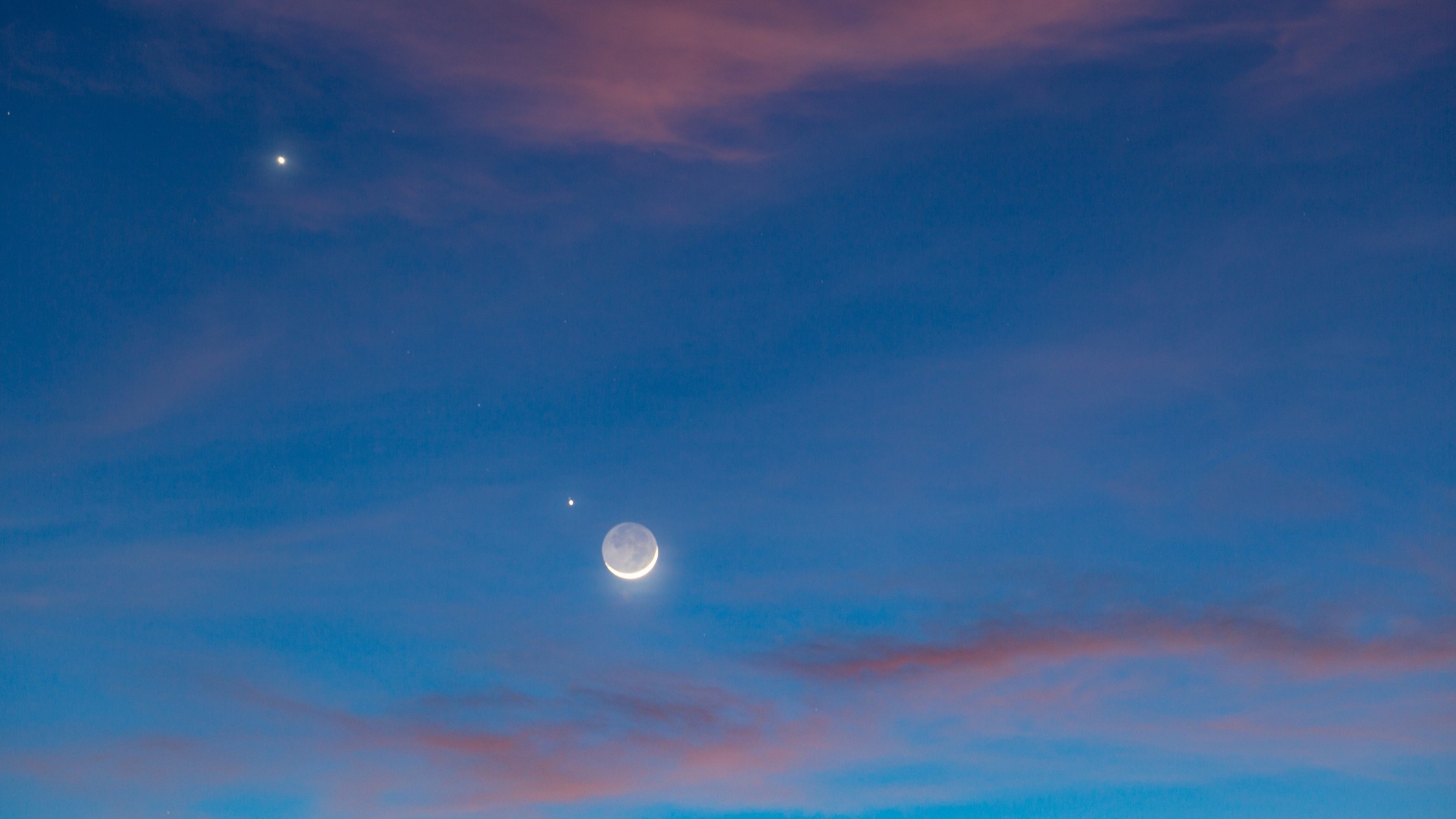
 Venus, Jupiter and Mercury headline May's skywatching, with stunning moon pairings and a three-planet display. (Image credit: by Chakarin Wattanamongkol via Getty Images) Share this article 0 Join the conversation Add us as a preferred source on Google Newsletter Subscribe to our newsletter
 The best planets to view this month are in the evening sky. Jupiter has been by far the best planet to observe both with the naked eye as well as through binoculars and telescopes these past several months, but its time is running out as it descends noticeably down the western sky during May. It continues to be placed near the "Twin Stars" of Gemini (Pollux and Castor) and the addition of a crescent moon passing by on May 20 makes for a rather attractive sky picture.
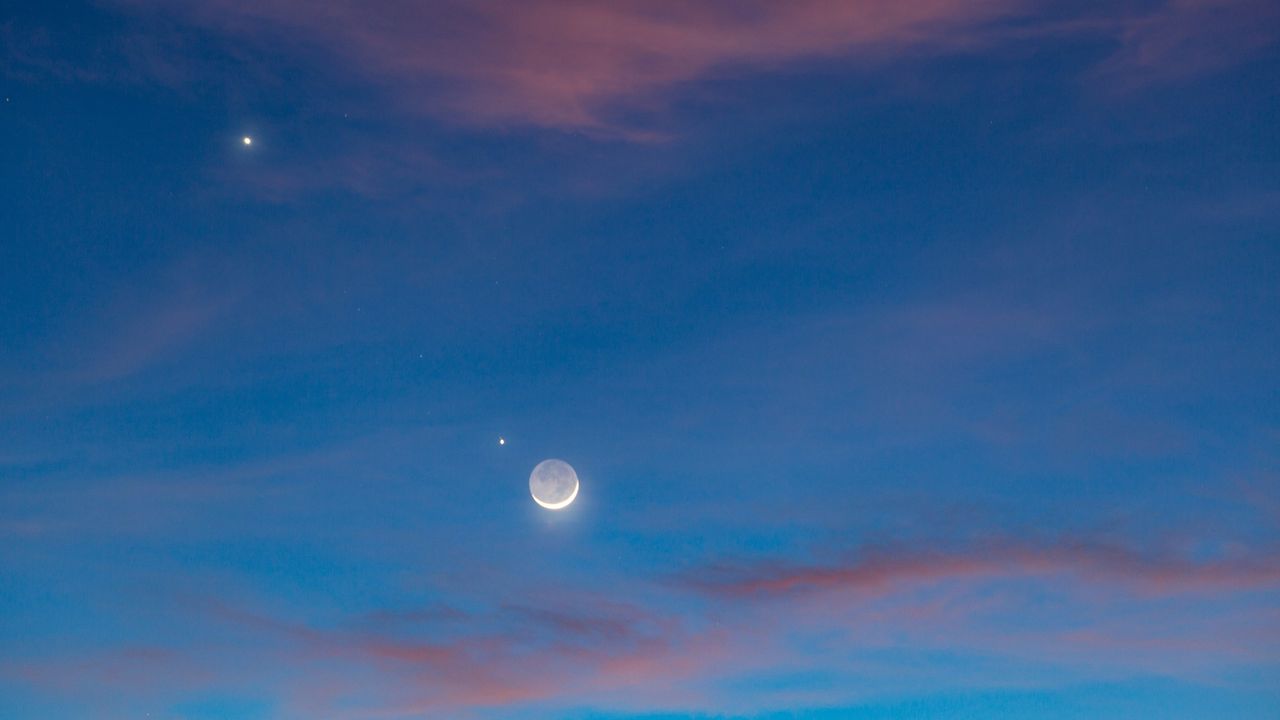
Although lower in the western sky, Venus shines about seven times brighter than Jupiter, yet continues to be rather disappointing in telescopes. Its gibbous disk appears small and featureless. With the naked eye and especially through good binoculars, its conjunction with a slender crescent moon on May 18 will be very pleasing to see. Earthshine will make the view seem almost three-dimensional.
Toward the end of the month, a third bright planet — Mercury — will begin to make its presence felt near the west-northwest horizon shortly after sunset.
As far as Saturn and Mars are concerned, the latter is gradually becoming easier to see in the morning sky, rising in the east just as dawn is breaking. Mars, which has been dawdling in the bright morning twilight since the start of 2026, continues to be a difficult object to spot, although you might be able to make use of a skinny crescent moon to lead you to it on May 14.
Mercury
Mercury is at superior conjunction on May 14. In fact, the speedy planet is occulted (hidden) by the sun's disk, but of course, this event is unobservable. Can you see it within a week after conjunction? Of magnitude -1.4 (as bright as Sirius) on May 22, it will be 10 degrees east of the sun and will follow it below the western horizon by about 55 minutes.
Using binoculars, begin looking a quarter hour after sundown, low in the west-northwest. By May 25, a magnitude -1.1 Mercury should be an easy naked-eye object. By the end of May, it will be obvious to spot, around 45 minutes after sunset, a negative magnitude "star" sitting well above the western horizon by roughly the width of a fist at arm's length. The peak of Mercury's apparition (for latitude 40 degrees north) and its greatest elongation from the sun don't occur until the middle of June.
Venus
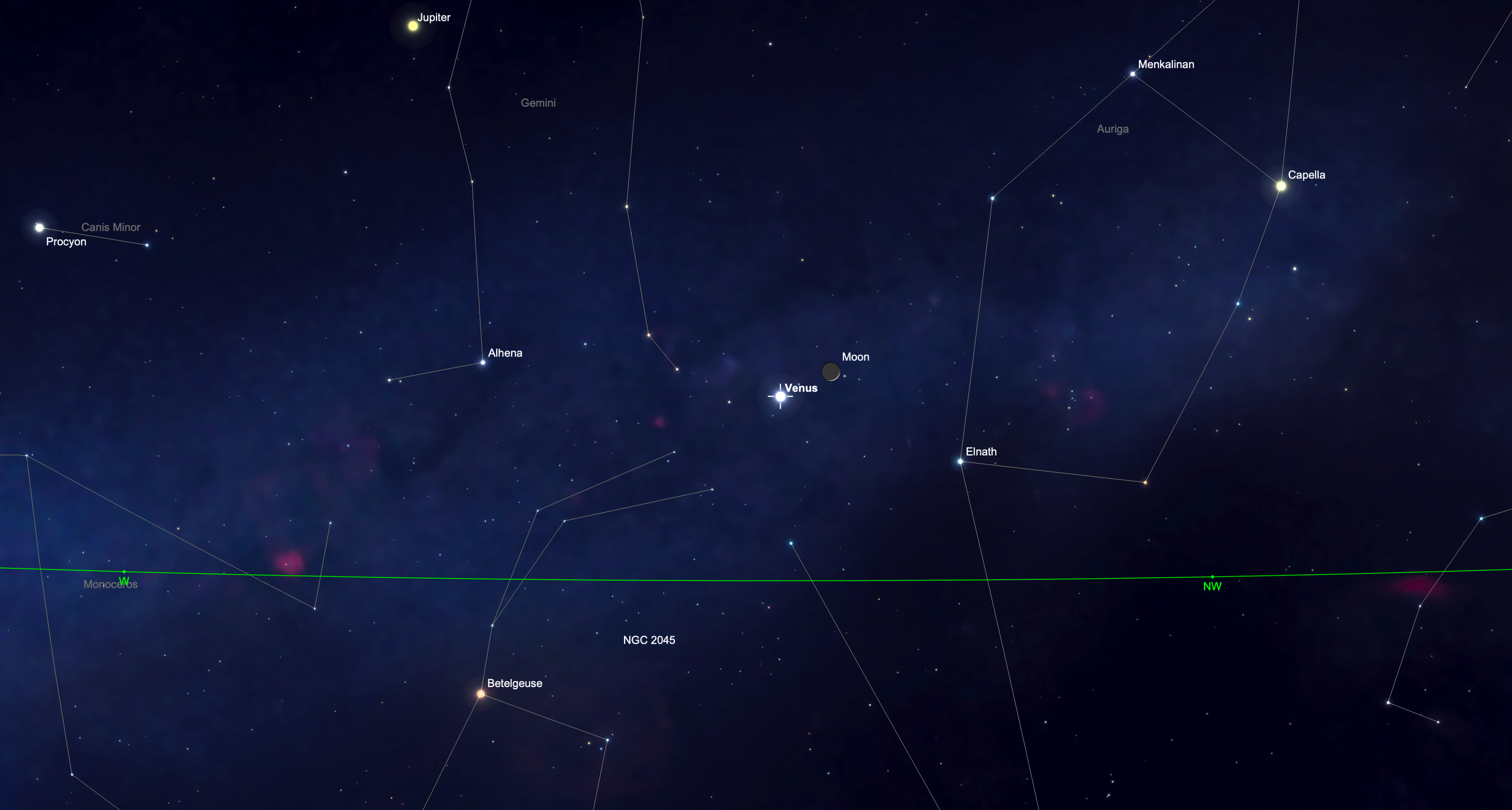
Venus hangs at practically the same height, moderately low in the west-northwest during evening twilight throughout the month of May. It shines at a dazzling magnitude of -4.0 but isn't especially interesting through a telescope yet. It still presents a small gibbous disk; 84 percent illuminated at midmonth. On May 18, nearly two days past new, a slender crescent moon, 7% illuminated, sits about 2.5 degrees to the right of Venus.
Mars
Mars languishes low in morning twilight for the fifth month in a row. Look for it coming up a little to the left of due east as twilight brightens. On the morning of May 14, the 8% sliver of the waning moon will be positioned about 7½ degrees to the upper right of the red planet.
At magnitude +1.2, Mars is difficult to see through the bright twilight, but this morning, with the moon's help, binoculars may be useful for sighting it, especially from latitudes higher than 35 degrees north.
Jupiter
Jupiter, as darkness falls, will be roughly one-third up from the western horizon to the point directly overhead. This is the last month (until September) in which this biggest of planets is high enough in a dark sky to permit crisp telescopic views of its cloud patterns and four big satellites. After the moon engages with Venus on May 18, look westward on May 20 to see a wider (24%-illuminated) crescent moon and about 7 degrees to its lower right will be brilliant (magnitude -1.9) Jupiter, which will set at around midnight local daylight time. Toward the end of the month, take note of how Venus appears to be creeping up toward Jupiter from the lower right.
See the moon shine close to Jupiter on May 20. (Image credit: Jules-Pierre Malartre/Starry Night)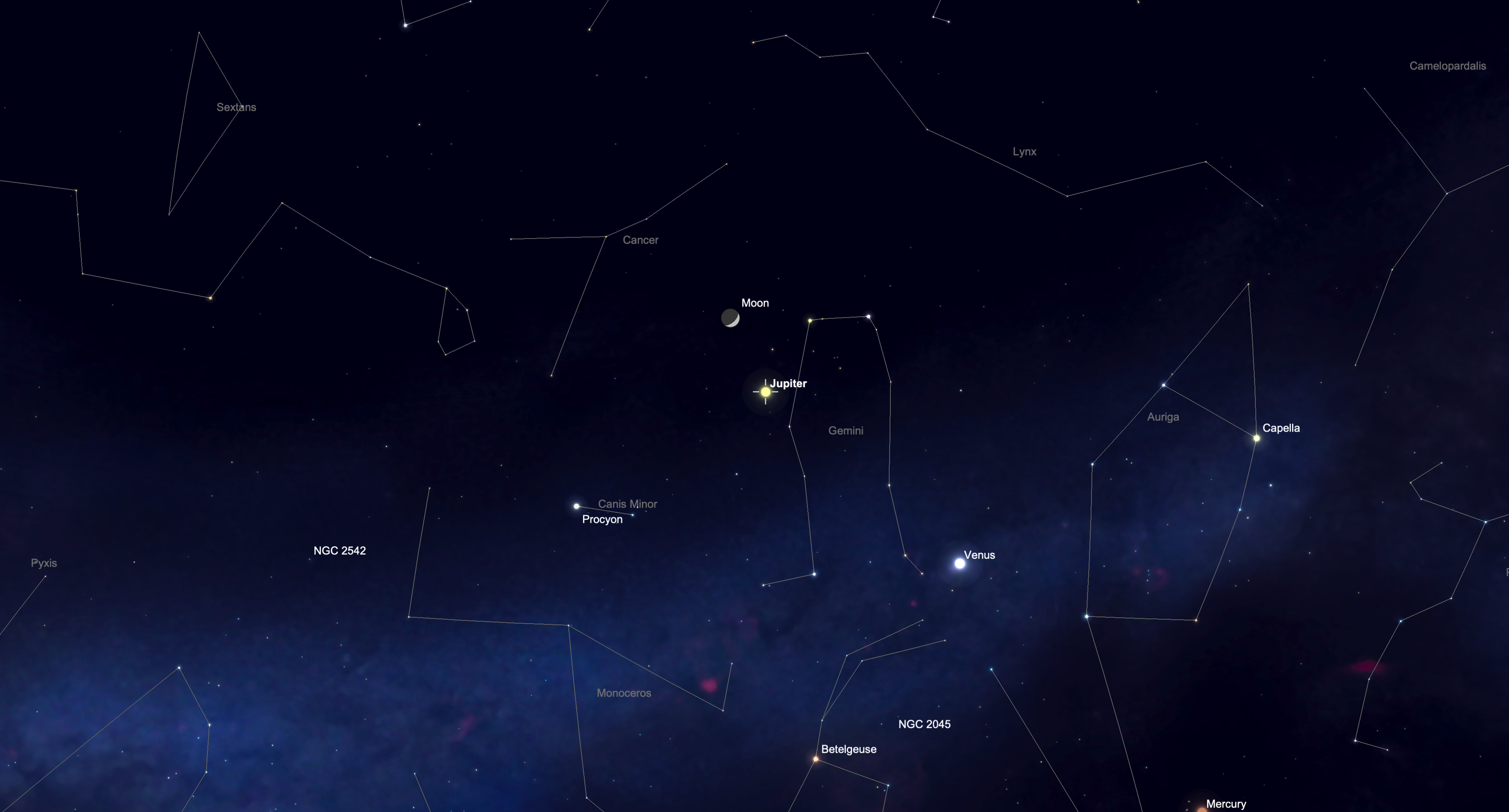
Saturn
Saturn, lurking near the border of the constellations Cetus the Whale and Pisces the Fishes, sneaks up in the east around the start of morning twilight. Early on the morning of May 13, you can catch it sitting about a half-dozen degrees to the lower left of a slender waning crescent moon.
Saturn's famous ring system is opening into view again, but the planet is still too low before sunrise for us to get a steady view. At least we can expect good things in the coming months and years. After spending 15 years at southerly declinations, Saturn has now edged north across the celestial equator, meaning we'll be seeing it at increasingly higher altitudes when it crosses the meridian in the years to come.
Joe Rao serves as an instructor and guest lecturer at New York's Hayden Planetarium. He writes about astronomy for Natural History magazine, Sky and Telescope, The Old Farmer's Almanac and other publications.
View MoreYou must confirm your public display name before commenting
Please logout and then login again, you will then be prompted to enter your display name.
Logout Joe RaoSkywatching Columnist
Joe Rao is Space.com's skywatching columnist, as well as a veteran meteorologist and eclipse chaser who also serves as an instructor and guest lecturer at New York's Hayden Planetarium. He writes about astronomy for Natural History magazine, Sky & Telescope and other publications. Joe is an 8-time Emmy-nominated meteorologist who served the Putnam Valley region of New York for over 21 years. You can find him on Twitter and YouTube tracking lunar and solar eclipses, meteor showers and more. To find out Joe's latest project, visit him on Twitter.