While rumors run rampant about what the Washington Wizards will do with the No. 1 pick and how that will dictate what happens with the Utah Jazz at No. 2, the Memphis Grizzlies have a decision to make at No. 3. It's an intriguing scouting debate, and right now, it's absolute crickets in terms of the Grizzlies showing their hand.
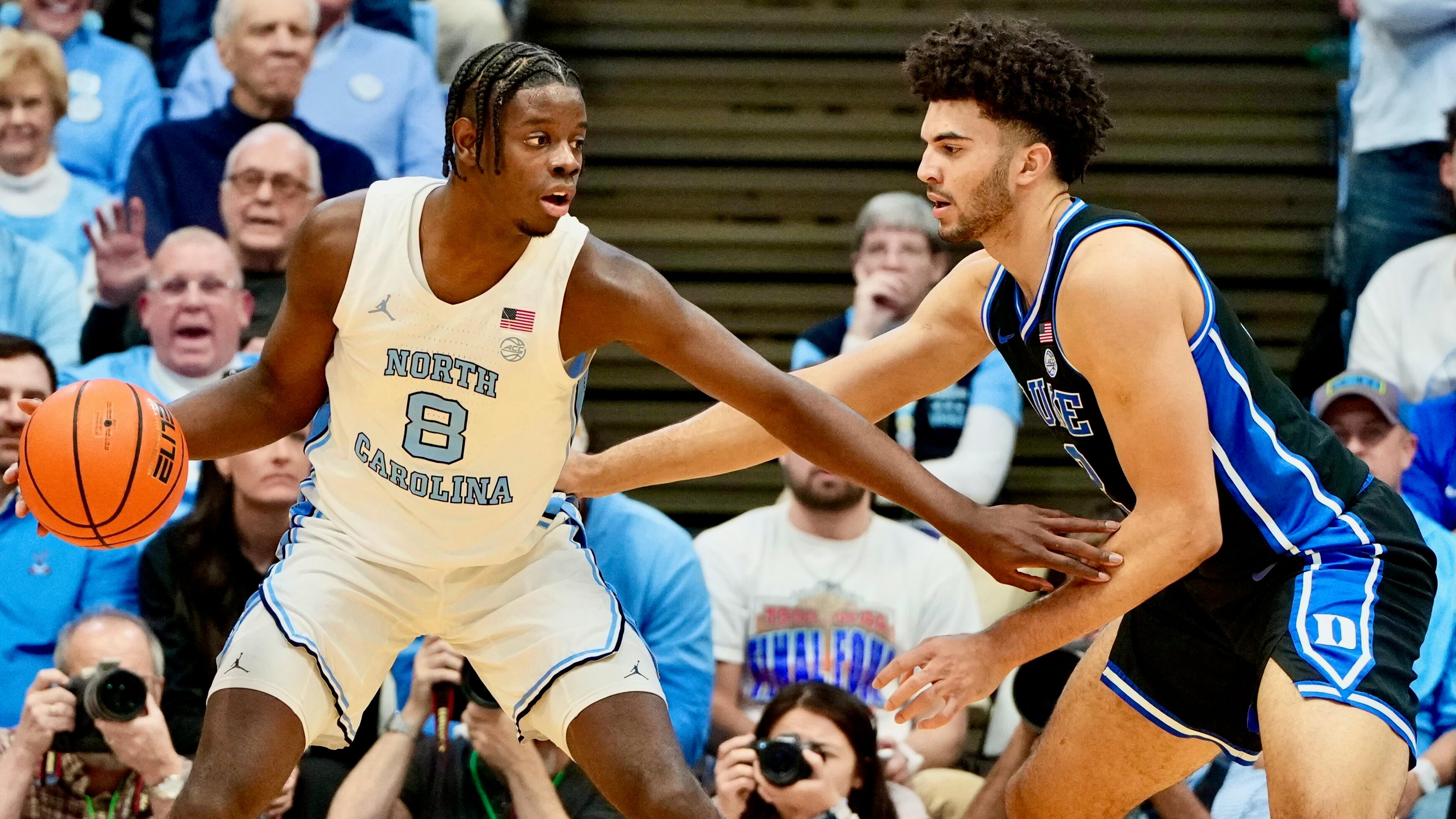
Conventional wisdom is that Memphis will end up choosing from among a pair of forwards, Duke's Cameron Boozer and North Carolina's Caleb Wilson. That means that right now the Grizzlies' brass are doing maximum due diligence on both players, trying to answer some of the most important questions in the process.
How will Cameron Boozer's athleticism translate to the NBA? And is Caleb Wilson the draft prospect with the most untapped upside?
Because of his last name, Cameron Boozer may be the most recognizable prospect in the 2026 NBA Draft. His father is Carlos Boozer, who won a National Championship at Duke and enjoyed a 14-year NBA career with two All-Star appearances.
Boozer has been on the NBA radar for years. He became the winningest high school and grassroots player ever before leading Duke to an ACC Championship, a 35-3 overall record and an appearance in the Elite Eight. Boozer was named a First-Team All-American and National Player of the Year after averaging 22.5 points, 10.2 rebounds, and 4.1 assists per game while shooting 55.6% from the field and 39.1% from three.
It was undoubtedly a spectacular college season, but the knock and questions for Boozer at the next level have always been about his athleticism and how that will translate in the NBA. Boozer is not a super dynamic athlete. He's not twitchy or overly explosive. And his game doesn't have flash or jump off the TV screen.
So let's break down and dive into the nuance of that very question.
How will Cameron Boozer's athleticism translate to the NBA?
This is a popular question and one that has been asked repeatedly for years now. It's also a nuanced answer because athleticism is a word that can encompass many physical characteristics, but is often oversimplified by the masses to mean little more than leaping ability, speed, and quickness. By those standards, Boozer may not be an overwhelming athlete, and there is data to support that observation. This year at Duke, he both got his shot blocked a decent amount (7% of the time) and also had a relatively low block rate as a defender himself. His combine measurements pointed in the same direction. His standing vert and max vert scores were the lowest of the top ten projected prospects on the CBS Sports Big Board and also behind virtually every other forward that is projected as a first-round lock (Nate Ament, Karim Lopez, Morez Johnson, Koa Peat), with the exception of Yaxel Lendeborg. Among that same group of forwards, Boozer was 4th out of 6 in lane agility, three-quarter-court sprint, and 5th in shuttle run.
Boozer's physical advantages
Basketball isn't track and field though, and Boozer's physical advantages tend to be more nuanced. That is with the exception of his power and physicality, which is very straightforward. He's a rock-solid 253 pounds and as strong in his lower body as he is in his upper body. If the combine measured sheer force, he likely would have led the way. He also personifies a "hit first" strategy that is critical to his 64% finishing at the rim. He not only goes right into his defender's body, but he has a way of doing it at angles that don't get called for offensive fouls (i.e. not in the center of the defender's body). When he makes that contact, he maintains his balance, but the opposition often loses their ability to elevate. Adding multiple fakes to the bump only accentuates his strategy and ideally negates whatever disadvantage he has in sheer leaping ability.
Way-too-early ACC basketball tiers: Duke, Louisville at top of 2026-27 outlook as intriguing contenders emerge Isaac Trotter
Elite hand-eye coordination
One of his more nuanced super powers is his hand-eye coordination. He's pretty well recognized for having elite hands --- he holds onto virtually everything he touches, but it is that initial coordination that is the basis for getting his hands on balls first, and conversely getting the ball out of his hands quickly without sacrificing his naturally soft touch. That helps him not just as a finisher, but also a rebounder and defender who can be active with his hands and generate a relatively high steal rate, without fouling. That can help to negate whatever he may lack in sheer footspeed in certain match-ups.
Overlooked fluidity
I've also long been a believer in the fluidity of Boozer's hips. In high school, I noted that he was smoother sliding laterally than he got credit for, and consequently more versatile defensively. Where he was more vulnerable was if he was forced to close out shooters and then immediately change his stride length and direction to have to slide laterally. That is hardly uncommon though, and sound defensive systems go to great lengths to keep their bigger defenders out of those types of long close-out situations.
Offensive skill set
Beyond his physical tools, Boozer's skill set is a major equalizer. The fact that he's such a versatile offensive player who not only makes spot-up threes (41%), but pull-up threes (37%), is a bulldozer off the bounce, and an exceptional passer, all keeps opposing defenders on their heels. In other words, he's not the type of player who has to rely on sheer explosiveness or athleticism to beat his defender; he's got more to his game than that. This gives Boozer potentially a longer runway for his career since his creation model shouldn't fade with the first signs of age.
Boozer's clear processing advantage
Most of all though, what differentiates Boozer is his brain. He's aware of it too. At last month's combine media availability, he was asked which of his skills he thought was the most transferable. He answered without hesitating, "My mind, for sure."
Add self-aware to his list of best assets.
Here's the reality of the modern NBA too. There may still be some superstars whose greatness is based on physical dominance, but those archetypes are fleeting. Instead, they're being replaced by the likes of Jokic, Doncic, Curry, and Brunson, who separate themselves with their skill and processing.
To say it another way, more often than not, there is a requisite amount of athleticism needed to be successful in the NBA, but it can be comprised in different ways, and it's rarely the differentiator. That comes down to who can think the game at the highest level.
Cameron Boozer is an adequate, if not above average, athlete for NBA standards. He's also an elite processor of the game with a consistently ascending skill set that continues to catch up.
That's why he's had the best career to date of any player in this class and why I'm betting on him being an ultra-successful pro…regardless of what his max vert was.
Does Caleb Wilson have the most untapped upside?
Boozer and Wilson went from grassroots teammates who won a Peach Jam championship together to opposite sides of college basketball's most storied rivalry. Now, they are competing for a top three spot in this year's draft. Although they play the same position, Boozer and Wilson are drastically different types of players.
While Boozer's game is based on physicality, skill, and processing, Wilson possesses all of the glaring athleticism that Boozer may lack. Wilson's 67 dunks in 2025-26 weren't just the most among freshmen; they were 13 more than the next highest in seven fewer games. His average of 2.8 dunks per game was even higher than what Zion Williamson did at Duke.
Wilson's athleticism and offensive development
Wilson isn't just a leaper, though; he's naturally mobile, covers the court effortlessly, and has rare elasticity, or bend, for a player his size that has been notable since high school.
What's changed since high school is his offensive game. Most people may not realize that it was just over two years ago that Wilson was struggling to live up to expectations as a consensus five-star recruit, in large part because he wasn't capable of being an offensive hub for even an EYBL team. His stock was only reinvigorated after he joined Boozer's Nightrydas team and thrived in a secondary role. That's why it was so surprising to see him be a volume scorer right away at UNC. There were contextual considerations for sure, specifically the ideal fit alongside Henri Veesaar in Carolina's frontcourt, but overall, he immediately and convincingly exceeded expectations on that end of the floor.
2026 NBA Mock Draft: Jazz take Caleb Wilson with No. 2 pick; Darryn Peterson slips to Grizzlies at No. 3 David Cobb
Defensive concerns in college
Unfortunately, the opposite was true on the defensive end. While the bevy of physical tools that were identified in high school were still glaringly obvious, they did not make him the defender we expected. He may have been very daunting when utilized at the top of the press, and generated a 7.2 stock percentage that ranks highest among the projected top ten in the draft, but there were still undeniable issues. His on-ball technique wasn't reliable, and even more glaring was his processing away from the ball (i.e. being in the right spots, making timely rotations, and showing general awareness).
Candidly, the consistency of Wilson's motor wasn't always where it needed to be on that end either, particularly away from the ball.
The topic of untapped potential on both sides of the ball
The question of untapped upside measures the distance between where a player is right now versus where they could be at their peak. In Wilson's case, his glaring athleticism coupled with the fact that he doesn't know how to fully utilize it yet defensively and has shown a more accelerated offensive learning curve than expected are all reasons for optimism.
Conversely though, for as good as he was offensively (20 points on 58% shooting), it remains to be seen how scalable his style will be. While the dunks, particularly when they were self-created, are encouraging, and he's likely the best lob threat in the class, post-ups were actually the part of his game he relied on the most for his individual offense (nearly 25%). Compound that with his willingness to shoot tough twos in the mid-range area, and that's not likely to translate.
Being a high-volume scoring threat in the NBA typically comes down to creation and shooting, and the two most inefficient aspects of Wilson's offensive game were when he spotted up (ranked in the 47th percentile) or operated in isolations (21st percentile). So, if you're betting on Wilson becoming a star, you are likely betting on significant growth in one, if not both, of these areas. It is not irrational to hope that the mid-range touch and solid free-throw shooting ultimately extend, but right now, he's more of a non-shooter who made just under 27% of his threes last year.
Similarly, Wilson's creation upside is rooted in his first step against opposing forwards, agility to change direction on his way to the rim, and even varying his stride length. But getting to the rim when defenders don't respect the threat of your jumper is hard enough. For Wilson, that's complicated by his lack of power and balance through contact right now, a handle that isn't fully weaponized, and the fact that he's surprisingly converting just 53% of his attempts at the rim when he's unable to dunk and even gets his shot blocked at a comparable rate to Boozer.
Wilson shows some encouraging signs as a passer, both in terms of his vision and accuracy, and if you're a believer in him, you're citing that as evidence that his overall processing, which wasn't what it needed to be on the defensive end, can grow in the coming years. Ultimately that may be the most important question to projecting his long-term worth.
What goes into the ultimate decision at No. 3 between Boozer and Wilson?
On draft night, NBA decision-makers are in the business of forecasting the future, which means they're betting on certain attributes.
In Boozer's case, you have elite skill, feel, and physicality, coupled with power, but debatable athleticism.
In Wilson's case, you have extreme athleticism coupled with an accelerated learning curve, but more uncertainties. If you believe the physicality, skill, and feel can catch up, then you subscribe to the argument that he has the most untapped upside and thus may be worthy of a top-three pick.
If it were me sitting in the war room, though, I'm betting on proven processing, especially when that's matched by physicality, durability, and skill. And recent draft history proves that is actually the higher upside bet.
Add CBS Sports on Google Join the Conversation comments